AI estimate as of July 18, 2025 · verify with a professional before acting
AI-Generated · Verify before acting
Everything on this page is generated by AI for informational purposes only. AI can make mistakes — the AI may misidentify items or misattribute them (artist, maker, brand, designer, origin, era). This is not an official valuation and should not be used for insurance, sale, tax, estate, legal, or lending purposes — or any decision requiring a certified appraisal. It is not an authoritative claim about any person, brand, or rights holder — do not share or rely on it as a factual statement about a third party. Always consult qualified professionals before making financial decisions.
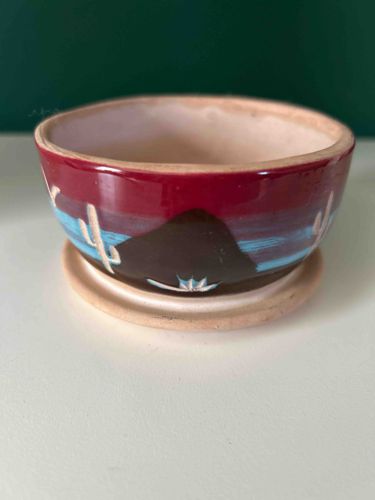
This item is a small, round ceramic planter or decorative bowl, featuring a hand-painted desert landscape motif. Its primary colors are a deep, glossy maroon/red on the upper exterior, transitioning down to a dark brown 'mountain' silhouette, with strokes of light blue/teal for the sky or water, and white detailing for cacti and other flora. The interior of the bowl appears to be an unglazed, light beige or natural clay color, contrasting with the vibrant exterior. The rim of the bowl is also unglazed, revealing the natural reddish-brown earthenware material underneath the glazed exterior. The base of the planter includes an integrated saucer or a similar unglazed ceramic ring designed to catch excess water, suggesting it is a planter rather than just a decorative bowl. The overall construction reveals a rustic, perhaps hand-thrown or molded ceramic piece, consistent with folk art or souvenir pottery. There are no immediately visible signs of significant damage such as chips or cracks, and the glaze appears largely intact, though minor wear or slight irregularities in the hand-painting may be present, consistent with its likely age and craftsmanship. The aesthetic suggests a mid-to-late 20th-century origin, possibly Southwestern American or Mexican artisan work, due to the desert theme and ceramic style. The quality of craftsmanship appears to be good for a handmade, decorative item, with clear attention to the painted details.
AI Appraisal Report
Upon visual examination of this Hand-Painted Desert Landscape Ceramic Planter with Saucer, I assess its condition as good. The glaze appears intact with no immediate chips or cracks visible from the provided image. Minor irregularities consistent with hand-painting and potential age are present but do not detract significantly from its aesthetic. The unglazed interior and base, along with the integrated saucer design, support its function as a planter. Authenticity, based solely on the image, suggests a mid-to-late 20th-century artisan piece, likely Southwestern American or Mexican, given the desert motif and ceramic style. This aligns with a folk art or souvenir pottery tradition.
In terms of market conditions, similar hand-painted ceramic planters of this style and period generally appeal to collectors of regional folk art, decorative pottery, or those seeking unique accent pieces. Comparables indicate active, though not high-value, niche markets for such items. Demand for this specific style is moderate, driven by collectors and interior decorators seeking rustic or Southwestern aesthetics. This particular piece's uniqueness benefits from its detailed hand-painting, which adds to its decorative appeal beyond a generic planter.
Factors significantly impacting value include its good condition, charming hand-painted design, and perceived artisan craftsmanship. The integrated saucer is a practical feature that adds to its desirability as a planter. While not rare, examples in good condition are less common than damaged pieces. Its value is primarily decorative and collectible within its specific niche.
Limitations in authenticity verification exist due to reliance on images alone. A physical examination would allow for tactile assessment of the ceramic quality, weight, and a more thorough inspection for hairline cracks, chips, and wear not immediately visible. In-person examination could also reveal maker's marks or signatures crucial for precise attribution. Provenance documentation, such as original purchase receipts or family history, would significantly enhance authentication and potentially value. Scientific testing, like thermoluminescence dating, is not typically warranted for items in this value range but could definitively establish age if required for high-stakes authenticity. Without physical inspection, I cannot definitively confirm the precise origin or specific artisan, only infer based on stylistic cues.