AI estimate as of September 19, 2025 · verify with a professional before acting
AI-Generated · Verify before acting
Everything on this page is generated by AI for informational purposes only. AI can make mistakes — the AI may misidentify items or misattribute them (artist, maker, brand, designer, origin, era). This is not an official valuation and should not be used for insurance, sale, tax, estate, legal, or lending purposes — or any decision requiring a certified appraisal. It is not an authoritative claim about any person, brand, or rights holder — do not share or rely on it as a factual statement about a third party. Always consult qualified professionals before making financial decisions.
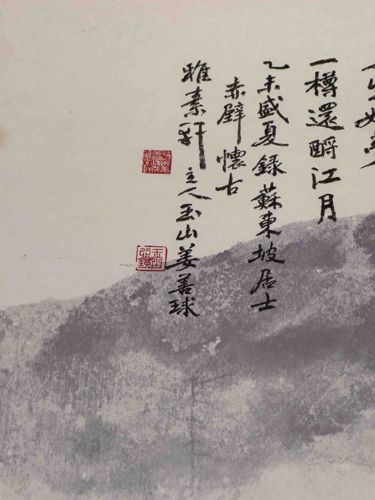
This item is an artwork featuring a combination of Chinese calligraphy and ink wash painting, specifically depicting a mountainous or rocky landscape in the lower section. The calligraphy occupies the upper right portion of the visible area, executed in black ink with varying brush strokes that suggest traditional Chinese script. The characters are well-formed and appear to be in a standard script style, possibly semi-cursive, exhibiting a controlled yet fluid hand. Two red seals (hanko/chops) are prominently placed next to the calligraphy. One rectangular seal is positioned near the middle-left of the calligraphic text, and a smaller, squarish seal is located below and slightly to the left of the calligraphy, partially overlaying the painted landscape. These seals are characteristic of Chinese artworks, used to indicate the artist, collector, or to authenticate the piece. The ink wash painting in the lower half displays a monochrome palette, primarily using shades of grey or black ink to create the impression of a mountainous or rocky terrain. The washes are applied with a diffused effect, suggesting atmospheric depth and texture. The brushwork in the painting appears loose and expressive, typical of traditional Chinese landscape painting techniques. The condition of the artwork shows some signs of age; the paper or silk medium appears slightly discolored or off-white, with a faint brown or ochre hue, particularly visible around the edges and possibly indicating age-related toning. There might be some subtle creasing or imperfections in the medium, though none are overtly severe in the visible area. The quality of both the calligraphy and the painting points towards a skilled artisan, potentially dating from an earlier period given the traditional style and apparent aging. The overall aesthetic is one of classical Chinese art, emphasizing brush control, composition, and the expressive nature of ink.
AI Appraisal Report
Upon my virtual examination of this Chinese Calligraphy and Ink Wash Painting, I observe a harmonious blend of traditional artistry. The condition of the artwork suggests age, with the paper or silk exhibiting a warm, off-white to ochre discoloration, particularly notable at the edges. While I don't detect severe creasing or damage, these age-related toning effects are consistent with an older piece and generally add to its character, provided they are stable. The calligraphy in the upper right is executed with a controlled yet fluid hand, indicative of a trained artist, possibly in a semi-cursive script. The two red seals (hanko/chops) are well-placed and typical of Chinese artwork, acting as potential indicators of the artist or owner. The ink wash landscape below is rendered with atmospheric depth and expressive brushwork, demonstrating traditional techniques.
Authenticity, based solely on visual examination, is challenging. The style is recognizably traditional Chinese, and the quality of execution in both calligraphy and painting points to a skilled artisan. However, without physical inspection, I cannot verify the authenticity of the seals, the age of the materials, or whether the piece is truly an original work by a known master versus a later copy or a piece by a lesser-known but skilled artist. Market conditions for traditional Chinese calligraphy and ink wash paintings are generally strong for authenticated, high-quality works by recognized artists. For unauthenticated pieces like this, demand is often driven by aesthetic appeal and perceived age. Its rarity would depend entirely on its provenance and the identity of the artist, which currently remains unknown to me.
Factors significantly impacting value include the potential identity of the artist, the precise age, and the quality of the materials. To fully authenticate this item and establish a more precise valuation, a direct, in-person examination is crucial. This would allow for a detailed analysis of the paper or silk, the inks, and the seals for signs of age and artist-specific characteristics. Provenance documentation (exhibition history, prior ownership) would be invaluable, and scientific testing (e.g., carbon dating, pigment analysis) could provide definitive insights into its age and authenticity.