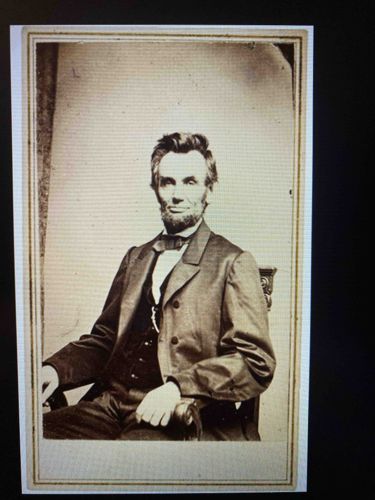
Abraham Lincoln: Anthony/Brady Carte-de-Visite. Very fine example of O-84, taken in Washington, D.C. on January 8, 1864. Anthony/Brady back mark.
These notes were written by the person who submitted this item. Appraiser.AI has not verified them, and the AI's identification and estimate may rely on them.
AI Estimated Value
Not an official valuation
$2,500 - $4,000
AI estimate as of July 18, 2025 · verify with a professional before acting
AI-Generated · Verify before acting
Everything on this page is generated by AI for informational purposes only. AI can make mistakes — the AI may misidentify items or misattribute them (artist, maker, brand, designer, origin, era). This is not an official valuation and should not be used for insurance, sale, tax, estate, legal, or lending purposes — or any decision requiring a certified appraisal. It is not an authoritative claim about any person, brand, or rights holder — do not share or rely on it as a factual statement about a third party. Always consult qualified professionals before making financial decisions.
This analysis also relies on unverified notes provided by the user, which may be incomplete or inaccurate and could affect the result.
This item is a carte-de-visite (CDV) featuring a photographic portrait of Abraham Lincoln, identified as O-84. The photograph is a black and white image, typical of mid-19th century photographic processes, displaying a sepia tone consistent with aging paper and photographic chemicals. Lincoln is depicted seated, facing slightly to his right, with a direct and somewhat contemplative expression. He is wearing a dark, possibly charcoal or black, suit jacket with a visible vest underneath and a white shirt with an ascot or cravat tied at the collar. His signature beard is present, indicating the period of the photograph. The physical characteristics suggest it is a small, thin photographic print mounted on a thicker cardstock, a standard format for cartes-de-visite, which were popular during the 1860s. The edges of the cardstock appear clean with a simple, thin border line framing the image. There are minor visible condition issues, including some slight discoloration or foxing evident primarily in the upper left corner background and a small dark speck near the center of the right edge, likely dust or a minor imperfection on the photographic plate or print surface. The overall condition appears very fine, with good tonal range for an antique photograph and sharp detail in Lincoln's face and clothing. The context indicates it was taken in Washington, D.C. on January 8, 1864, placing its estimated age at 1860s. The manufacturing details specify an 'Anthony/Brady back mark,' which refers to the photographic firm of E. & H.T. Anthony, who often distributed photographs for Mathew Brady. This attribution signifies a notable, high-quality photographic studio of the era, implying a well-crafted and historically significant piece.
AI Appraisal Report
Based on my visual examination of the provided image, this Abraham Lincoln: Anthony/Brady Carte-de-Visite (O-84) presents as a very fine example. The photographic detail is sharp, with good tonal range for a mid-19th-century salted paper print or albumen print, and clearly depicts Lincoln's O-84 pose from January 8, 1864. The 'Anthony/Brady back mark' is a significant positive factor, associating it with one of the most prominent photographic studios of the era, enhancing its authenticity and historical provenance. Condition appears very strong; the minor foxing in the upper left corner and the small speck on the right edge are typical age-related imperfections and do not significantly detract from the overall aesthetic or value for a piece of this antiquity. The clean edges and simple border are consistent with CDV production standards.
Market conditions for authentic Lincoln photographs, particularly well-preserved CDVs from known sittings, are consistently robust. Comparables of O-84 with Anthony/Brady imprints generally command strong prices at auction and through reputable dealers. Demand for original Lincoln iconography remains high among collectors of presidential memorabilia, Civil War artifacts, and photographic history. The rarity of well-preserved, authentic examples, combined with the desirability of the subject, contributes significantly to its value.
However, it is crucial to state that this appraisal is based solely on visual inspection of a digital image. While the image strongly suggests authenticity and the described excellent condition, definitive authentication requires in-person examination. Physical inspection would allow for direct assessment of paper type, photographic process, exact dimensions, and the tactile verification of the 'Anthony/Brady back mark' against known genuine examples. Furthermore, provenance documentation beyond the general description would solidify its history. Scientific testing, such as spectroscopy for paper and chemical analysis, could definitively confirm the period materials, although this is usually reserved for higher-value or contested items. Without direct physical inspection and a full review of provenance, I cannot issue an unequivocal guarantee of authenticity; however, based on the provided details and image, it appears highly authentic and desirable.