AI identification & appraisal estimate

Signed Oil Painting Detail

Submitted photo of Signed Oil Painting Detail
Photo submitted by the user — not generated by AI

AI Estimated Value

Not an official valuation

$600-900

AI estimate as of September 5, 2025 · verify with a professional before acting

AI-Generated · Verify before acting

Everything on this page is generated by AI for informational purposes only. AI can make mistakes — the AI may misidentify items or misattribute them (artist, maker, brand, designer, origin, era). This is not an official valuation and should not be used for insurance, sale, tax, estate, legal, or lending purposes — or any decision requiring a certified appraisal. It is not an authoritative claim about any person, brand, or rights holder — do not share or rely on it as a factual statement about a third party. Always consult qualified professionals before making financial decisions.

Read the full disclaimer

AI Item Analysis

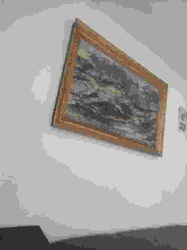
This item is a close-up detail of what appears to be an oil painting, specifically focusing on the artist's signature or inscription and a section of the gilded frame. The visible portion of the artwork features a dark, textured surface, likely painted with oil media given the visible brushstrokes and impasto. The color palette in the painting itself is predominantly dark green, suggesting perhaps foliage or a dark landscape. The signature, inscribed in black or a very dark pigment, appears to read 'J.V.L.' or 'T.V.L.' followed by what could be 'W' or another letter/symbol, although the precise legibility is challenging due to the texture of the paint and the cursive style. The medium of the signature appears to be paint as well, seamlessly integrated into the top layer of the artwork. The painting is housed within a gilded wooden frame, exhibiting signs of age and ornate craftsmanship. The frame features decorative molded elements, specifically visible at the bottom left corner where a foliate or scroll design is present. The gold leaf or paint on the frame shows some wear, patination, and minor chipping, revealing a darker underlayer in some areas, indicative of its age and handling. This wear contributes to an aged aesthetic rather than significant damage. The overall quality of the frame suggests it is a traditional piece designed for a fine art painting. Based on the style of the frame and the appearance of the signature, the piece likely dates from the late 19th to early 20th century. The visible texture and rich, dark tones point to a traditional representational style.

AI Appraisal Report

Based on my visual examination of the provided image, this oil painting detail presents well. The visible areas of the painting exhibit characteristics of traditional oil media, with noticeable brushstrokes and impasto. The condition of the painting appears stable, with no obvious signs of cracking or paint loss within the detail provided. The signature, 'J.V.L.' or 'T.V.L.' followed by another character, while challenging to definitively decipher from an image, indicates the work is signed, which is a positive factor for attribution. The gilded frame is consistent with late 19th to early 20th-century craftsmanship; its wear and patination are commensurate with age and contribute to its historic charm rather than detracting significantly from value. In terms of market conditions, unsigned or minimally identifiable traditional oil paintings of modest size (which this detail suggests) from this period typically fall into a broader decorative arts market. Comparable works, often by lesser-known artists, generally sell in the mid to high hundreds. Demand for such pieces is steady but not exceptionally high unless an artist's identity is clearly established and has a robust market presence. The rarity of this specific piece is indeterminate without knowing the artist. Factors significantly impacting value include the precise identification of the artist. Should the signature correlate to a recognized or listed artist, the value could increase substantially. Without this, it primarily functions as an attractive antique decorative object. It is crucial to note the limitations of authenticity verification from images alone. I can assess stylistic consistency and apparent condition, but full authentication would require in-person examination to verify paint layers, canvas, and stretcher type. Furthermore, provenance documentation would be essential to trace ownership history. Scientific testing, such as pigment analysis or dendrochronology (if on panel), could provide further dating and authenticity insights. Without these, the appraisal remains an estimation based on observable characteristics.

Keep exploring

More fine art appraisals

Get your items appraised

Instant AI-powered appraisal estimates from a photo

Browse More Appraisals