These notes were written by the person who submitted this item. Appraiser.AI has not verified them, and the AI's identification and estimate may rely on them.
AI Estimated Value
Not an official valuation
$300-500
AI estimate as of October 7, 2025 · verify with a professional before acting
AI-Generated · Verify before acting
Everything on this page is generated by AI for informational purposes only. AI can make mistakes — the AI may misidentify items or misattribute them (artist, maker, brand, designer, origin, era). This is not an official valuation and should not be used for insurance, sale, tax, estate, legal, or lending purposes — or any decision requiring a certified appraisal. It is not an authoritative claim about any person, brand, or rights holder — do not share or rely on it as a factual statement about a third party. Always consult qualified professionals before making financial decisions.
This analysis also relies on unverified notes provided by the user, which may be incomplete or inaccurate and could affect the result.
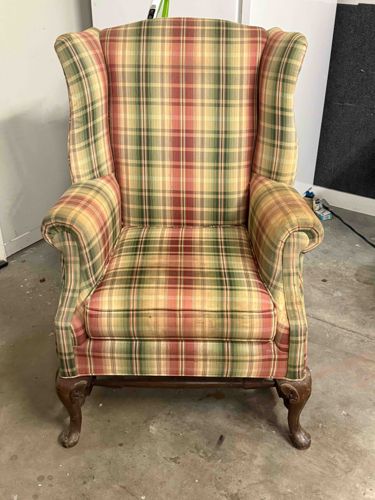
This is a classic wingback armchair featuring a vibrant plaid upholstery pattern. The dominant colors in the tartan are various shades of red, green, and yellow/beige, arranged in a traditional crisscross pattern that creates a warm and inviting aesthetic. The chair has prominent 'wings' on the backrest, characteristic of the wingback style, which extend forward from the main back panel, providing a cozy and enclosed seating experience. The armrests are traditional rolled or padded styles, offering comfortable support. The construction includes a robust wooden frame, visible in the four cabriole legs at the base. These legs are dark-stained wood, possibly mahogany or walnut, and feature carved details, most notably a ball-and-claw foot design on at least the front legs, indicating a possible Queen Anne or Chippendale influence. The overall condition appears to be fair to good, with some visible wear consistent with age and use, such as minor discoloration or possible light staining on the upholstery, particularly on the seat cushion. The fabric shows some signs of gentle wear, but no major tears or rips are immediately apparent. The craftsmanship of the carved legs suggests a certain level of quality and attention to detail in its manufacture. This type of chair typically dates from the mid-20th century onwards, often a reproduction of 18th-century styles, and provides a comfortable and stylish piece of accent furniture.
AI Appraisal Report
Upon my virtual examination of this Plaid Wingback Armchair with Cabriole Legs, I assess its condition as fair to good. The vibrant plaid upholstery, with its traditional red, green, and yellow/beige tartan, appears largely intact, though there are indications of wear consistent with age and use, such as minor discoloration or light staining on the seat cushion. No significant rips or tears are immediately visible from the image provided. The robust wooden frame, particularly the dark-stained cabriole legs with carved details and ball-and-claw feet, suggests a quality reproduction in the Queen Anne or Chippendale style, likely dating from the mid-20th century onwards.
Market conditions for plaid wingback armchairs, especially reproductions, are generally stable but not exceptionally high. While there's a consistent demand for comfortable and aesthetically pleasing accent furniture, the market is well-supplied with similar pieces. The 'Silver' detail provided by the owner doesn't offer additional information for authentication visible in the image. The charm of the plaid pattern and the classic leg design contribute positively to its appeal.
Factors significantly impacting its value include the overall good structural integrity and the attractive, though slightly worn, upholstery. However, the absence of any notable rarity or unique historical provenance limits its upper value. Without a physical inspection, however, I cannot definitively verify the wood type, the extent of upholstery wear or damage, the frame's stability, or the exact period of manufacture. An in-person examination would allow for a thorough inspection of the upholstery for hidden damage, assessment of the spring and cushion integrity, and a professional evaluation of the wood and construction methods to confirm authenticity and period more accurately. Provenance documentation, if available, could also significantly impact the valuation.