AI estimate as of June 21, 2025 · verify with a professional before acting
AI-Generated · Verify before acting
Everything on this page is generated by AI for informational purposes only. AI can make mistakes — the AI may misidentify items or misattribute them (artist, maker, brand, designer, origin, era). This is not an official valuation and should not be used for insurance, sale, tax, estate, legal, or lending purposes — or any decision requiring a certified appraisal. It is not an authoritative claim about any person, brand, or rights holder — do not share or rely on it as a factual statement about a third party. Always consult qualified professionals before making financial decisions.
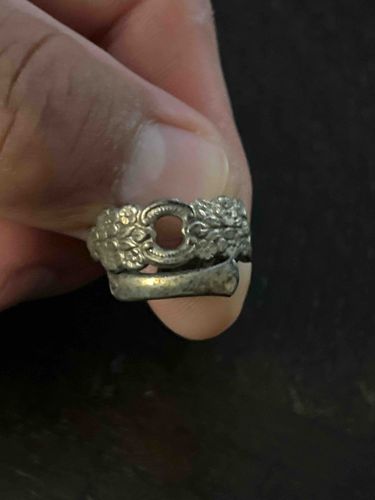
This is a silver-toned spoon ring, likely crafted from the handle of an antique or vintage spoon. It features an ornate, deeply embossed design, appearing to be floral or foliate in nature, possibly acanthus leaves or similar scrolls. The ring's construction shows the typical 'wrap-around' style of a spoon ring, where the handle is bent to form a circular band, with the two ends overlapping or meeting on the underside. There is a distinct open circular cut-out detail visible on the top center of the ring, which is integral to the spoon handle's original design. The metal exhibits a dark patina in the recessed areas of the design, which enhances the intricate details and suggests age or intentional antiquing. There are visible signs of wear, including surface scratches and some loss of luster, particularly on the smoother, less decorated sections of the band. The material appears to be sterling silver or silver plate, given the color and typical use for such items. Without clear hallmarks, the exact metal content cannot be definitively confirmed from the image alone. The style suggests a Victorian or Art Nouveau influence, common in spoon handle designs from the late 19th to early 20th century. The craftsmanship is consistent with repurposed flatware, demonstrating a balance of decorative intricacy and functional modification. The ring is a unique piece, showcasing the transformation of everyday utilitarian objects into personal adornment.
AI Appraisal Report
I have carefully examined the provided image of this ornate silver-toned spoon ring. Based on the visual evidence, it appears to be a genuine spoon ring, repurposed from a vintage or antique flatware handle. The deeply embossed floral or foliate design, along with the distinct circular cut-out, strongly suggests a late 19th to early 20th-century origin for the original spoon, aligning with Victorian or Art Nouveau aesthetics.The condition of the ring shows expected wear for a repurposed item of its age, including surface scratches and a natural dark patina in the recessed areas, which actually enhances the design. This patina suggests age or intentional antiquing and is generally desirable. Authenticity, in terms of it being a true spoon ring from an older piece of flatware, seems credible from the image.However, without hallmarks, I cannot definitively confirm the metal content. While it presents as sterling silver or silver plate, an in-person examination or possibly non-destructive metal testing (like XRF) would be necessary to confirm sterling silver, which would significantly impact its value. Provenance documentation, if available, could also provide valuable insight into its history and original material.Market demand for unique, handcrafted, or repurposed jewelry remains consistent, particularly for pieces with an antique aesthetic. Spoon rings, especially those with intricate designs like this one, have a niche but steady collector base. While not exceedingly rare, a well-preserved and artfully designed example adds to its desirability.Comparables in the market for silver-plated or unmarked silver spoon rings with good design typically range from $30 to $75. If it were confirmed sterling silver post-1900, the value might be $75-$150, and if antique sterling silver, possibly $150-$250, depending on the maker. Without confirmation of sterling silver, its value is limited to its aesthetic appeal and the labor involved in its creation.My primary limitation in this appraisal is the inability to physically inspect the piece for hallmarks, precise metal composition, and tactile assessment of its condition and craftsmanship. This significantly impacts the certainty of material value.