AI Appraisal Estimate

AI-generated estimates · not official valuations

From the user

What was submitted

Photo and notes provided by the user — not generated by AI

Submitted item photo
Submitted photo · June 3, 2026

User's notes

No additional notes provided.

AI analysis below

AI appraisal

AI analysis & estimate

AI-Generated · Verify before acting

Everything below is generated by AI for informational purposes only. AI can make mistakes — the AI may misidentify items or misattribute them (artist, maker, brand, designer, origin, era). This is not an official valuation and should not be used for insurance, sale, tax, estate, legal, or lending purposes — or any decision requiring a certified appraisal. It is not an authoritative claim about any person, brand, or rights holder — do not share or rely on it as a factual statement about a third party. Always consult qualified professionals before making financial decisions.

Read the full disclaimer

AI Identification

·Not independently authenticated·Verify before acting

American Naive Folk Art Landscape Painting

Fine Art - Paintings

AI Estimated Value

·Not an official valuation·Verify before acting

$4,500 - $6,500

As of June 3, 2026

AI Item Analysis

·AI can make mistakes·Verify before acting
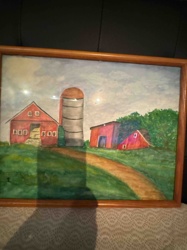
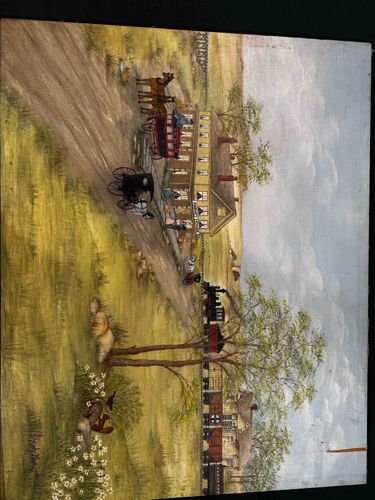
This is an original folk art painting executed in a naive or primitive style, likely oil or acrylic on a textured support such as canvas or board. The composition captures a detailed 19th-century American scene featuring various modes of transportation, including a horse-drawn stagecoach, a black buggy, and an early steam-powered locomotive with multiple freight cars. The focal point is a two-story yellow building identified by a sign as the 'Valley House.' The landscape uses a muted palette of earthy greens, ochres, and brownish-tans, with a pale blue-grey sky filled with soft, puffy clouds. In the foreground, white wildflowers and a small animal, possibly a fox or squirrel, add a touch of charming detail typical of folk art. The perspective is slightly flattened, which is a hallmark of self-taught artistry. The condition appears stable, though there is visible surface wear, particularly a vertical brownish marking or scuff on the lower right edge and some minor edge fraying on the left side. No visible signature is prominent in the provided orientation, but the brushwork is deliberate and repetitive, reflecting high-quality craftsmanship within the folk tradition. Historically, the piece evokes the mid-to-late 19th-century transition of the American frontier.


AI Appraisal Report

·AI can make mistakes·Verify before acting
Based on my visual examination of this American Folk Art landscape, I have identified it as a high-quality example of the 19th-century 'Naive' tradition. The 'Valley House' composition is particularly desirable due to its simultaneous depiction of a stagecoach, buggy, and steam locomotive, illustrating the Industrial Revolution's impact on rural life. The flattened perspective and repetitive brushwork are quintessential characteristics of a skilled, possibly itinerant, self-taught artist. The palette and subject matter align with the school of New England or Mid-Atlantic folk painters. While the surface shows an aged patina and minor scuffing on the lower right, the overall structural integrity appears stable. The market for mid-18th to late-19th-century Americana remains robust, with collectors placing high premiums on 'transportation' scenes and identifiable architecture. Comparable works from the American folk tradition featuring similar narrative complexity often realize mid-to-high four-figure sums at specialized auctions. However, this appraisal is subject to several limitations. Authenticity and age cannot be definitively confirmed via digital images alone. A physical inspection is required to analyze the substrate, pigment composition, and UV fluorescence to rule out modern reproductions or excessive overpainting. The current valuation assumes the piece is an original 19th-century work on its primary support. For a full authentication, I recommend a provenance review (chain of ownership) and an examination of the stretcher bars/nails for period-correct hardware. Despite the lack of a visible signature, the work's inherent charm and historical narrative make it a significant piece for folk art enthusiasts.

Get your items appraised

Instant estimates of your treasures with AI-powered appraisals

Browse More Appraisals