AI estimate as of October 5, 2025 · verify with a professional before acting
AI-Generated · Verify before acting
Everything on this page is generated by AI for informational purposes only. AI can make mistakes — the AI may misidentify items or misattribute them (artist, maker, brand, designer, origin, era). This is not an official valuation and should not be used for insurance, sale, tax, estate, legal, or lending purposes — or any decision requiring a certified appraisal. It is not an authoritative claim about any person, brand, or rights holder — do not share or rely on it as a factual statement about a third party. Always consult qualified professionals before making financial decisions.
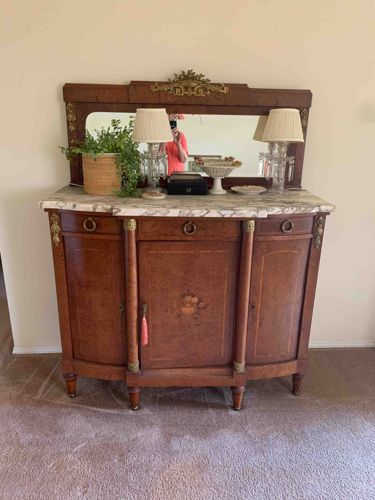
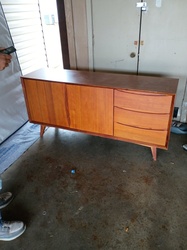
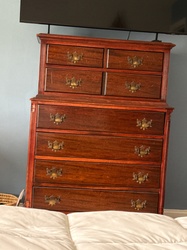
This is an Empire style sideboard or buffet with an integrated mirror, likely dating to the late 19th or early 20th century, though its classical inspirations harken back to the early 19th-century Empire period. The furniture piece is constructed from a rich, reddish-brown wood, likely mahogany or a similar veneer, exhibiting a burl wood pattern on the door panels and possibly other sections, which adds visual depth and a luxurious appearance. It features a serpentine or bowed front profile, characteristic of many classical furniture designs. The top surface is adorned with a polished white marble slab, heavily veined with grey, which provides a durable and elegant counterpoint to the wood. The sideboard is supported by four turned legs with brass or gilt metal sabots. Adorning the piece are numerous brass and gilt bronze mounts, including impressive caryatid-like figures with winged shoulders flanking the central mirrored section, circular drop pull handles on the drawers and doors, and decorative elements on the pilasters and frieze. A prominent gilt brass or ormolu cartouche with foliate and scroll motifs crowns the mirror. The central door features an inlaid or painted floral motif, suggesting marquetry or painted decoration. Visible condition issues include some wear and possibly tarnishing to the metal mounts, consistent with age. There may be minor abrasions or scratches to the wood finish and marble, though these are not clearly discernible without closer inspection. The overall craftsmanship appears to be of high quality, with attention to decorative detail and the use of fine materials, indicating a piece intended for a formal setting. The mirror itself shows some signs of age, potentially with minor silvering loss, but appears functional.
AI Appraisal Report
I have examined this Empire Style Mirrored Sideboard/Buffet and estimate its value to be in the range of $3,000 to $5,000. This piece likely dates to the late 19th or early 20th century, drawing heavily from early 19th-century Empire designs. The use of a rich, reddish-brown wood, likely mahogany or veneer with burls, indicates quality. The serpentine front and white marble top with visible veining are attractive features, enhancing its classical appeal.
The condition appears consistent with age. I note some wear and potential tarnishing on the brass/gilt metal mounts, which is expected. While not clearly visible, minor abrasions to the wood, slight silvering loss on the mirror, and minor chips to the marble are common for pieces of this vintage and would be assessed in a physical inspection. The craftsmanship, evident in the detailed caryatids, drop pulls, and the ornate cartouche, is of good quality, suggesting it was intended for a formal setting.
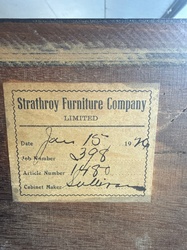
From the image alone, I cannot definitively confirm the wood species (e.g., solid mahogany versus a high-quality veneer) or the exact material of the metal mounts (brass vs. ormolu). In-person examination would also be required to assess the integrity of joints, any repairs, and the precise condition of the inlaid or painted floral motif on the central door. Provenance documentation would further confirm authenticity and historical significance. Nevertheless, the elaborate style, quality materials, and decorative elements suggest a strong market for such pieces among collectors of antique European furniture. Demand for well-preserved, ornate pieces like this remains steady, particularly those with a versatile form such as a sideboard or buffet.