AI estimate as of September 13, 2025 · verify with a professional before acting
AI-Generated · Verify before acting
Everything on this page is generated by AI for informational purposes only. AI can make mistakes — the AI may misidentify items or misattribute them (artist, maker, brand, designer, origin, era). This is not an official valuation and should not be used for insurance, sale, tax, estate, legal, or lending purposes — or any decision requiring a certified appraisal. It is not an authoritative claim about any person, brand, or rights holder — do not share or rely on it as a factual statement about a third party. Always consult qualified professionals before making financial decisions.
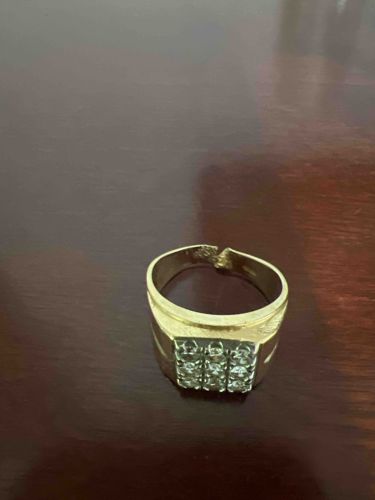
This item is a men's ring, appearing to be constructed from a gold-toned metal, likely yellow gold or a gold-plated base metal alloy. The primary color is a warm, lustrous gold. The band features a wide, flat top surface, characteristic of a 'signet' or 'men's fashion' ring style. On the face of the ring, there is a rectangular inlay featuring nine small, clear, round faceted stones, possibly cubic zirconia or diamonds, arranged in a grid of three rows by three columns. Each stone is individually prong-set into a white-colored metal setting, which contrasts subtly with the main gold-toned body of the ring. The side shoulders of the ring taper down from the wide face to a slightly narrower but still substantial band at the back. There appears to be some texture or subtle detailing on the surface of the gold-toned metal, possibly a brushed or satin finish on the sides, adding to its visual interest. The overall condition shows signs of wear, particularly noticeable on the back of the band where there is a visible indentation or possibly a sizing alteration that has left a discontinuity or slight crimp, suggesting it has been worn regularly or previously adjusted. The metal surface also exhibits minor scratches consistent with general use. No specific maker's marks or hallmarks are immediately visible in the provided image, thus the material purity (if gold) or brand cannot be determined without further inspection. The design suggests a mid to late 20th-century to contemporary style, often seen in men's jewelry.
AI Appraisal Report
I have examined the provided image of this men's gold-toned ring with inset faceted stones. Visually, the ring presents as a men's fashion piece, likely a signet style, crafted from a gold-toned base metal or perhaps gold-plated material given the visible wear and the absence of clear hallmarks. The warm, lustrous gold color is attractive, and the detailing includes nine clear, round faceted stones, possibly cubic zirconia, arranged in a 3x3 grid, individually prong-set into white-colored metal settings. The side shoulders taper down, and there appears to be some subtle texture on the gold-toned metal, possibly a brushed finish.
Condition-wise, the item shows clear signs of wear consistent with regular use. Most notably, there is an indentation or crimp on the back of the band, suggesting a likely sizing alteration or significant impact, which impacts its aesthetic appeal and structural integrity. Minor surface scratches are also visible.
Authenticity of the metal composition (e.g., solid gold vs. plated) and the identity of the stones (e.g., diamond vs. CZ) cannot be definitively determined from images alone. Without hallmarks, it’s highly probable this is a gold-plated or base metal item with synthetic stones. This significantly impacts value.
Based on these observations, and assuming the metal is gold-plated or base metal and the stones are synthetic, the market conditions for such pieces are generally modest. Demand is low for used, unsigned fashion jewelry of this presumed material. Comparables would include mass-produced men's fashion rings. Factors significantly impacting value are the unknown material purity (likely low), the uncertain stone identification (likely synthetic), and the visible wear and damage.
To fully authenticate materials and provide a more precise valuation, an in-person examination would be required for metal testing (acid test or XRF analysis), stone identification using gemological tools, and a thorough inspection for any hidden hallmarks or maker's marks. Without this, I must appraise it as a fashion piece with synthetic stones and compromised condition.