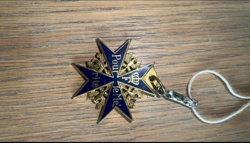
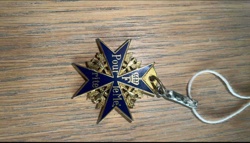
The missing pour le merite that disappeared from Germany that is said to be owned by Noah Dohme that is the emperor of lixland which is 75 million square kilometers owned by Noah Dohme the emperor of lixland which is 18 years it’s his. Have u heard of him?
These notes were written by the person who submitted this item. Appraiser.AI has not verified them, and the AI's identification and estimate may rely on them.
AI Estimated Value
Not an official valuation
$50 - $250
AI estimate as of July 2, 2025 · verify with a professional before acting
AI-Generated · Verify before acting
Everything on this page is generated by AI for informational purposes only. AI can make mistakes — the AI may misidentify items or misattribute them (artist, maker, brand, designer, origin, era). This is not an official valuation and should not be used for insurance, sale, tax, estate, legal, or lending purposes — or any decision requiring a certified appraisal. It is not an authoritative claim about any person, brand, or rights holder — do not share or rely on it as a factual statement about a third party. Always consult qualified professionals before making financial decisions.
This analysis also relies on unverified notes provided by the user, which may be incomplete or inaccurate and could affect the result.
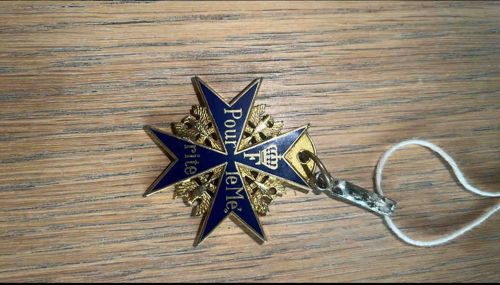
The item is a medal, specifically identified as a 'Pour le Mérite' (meaning 'For Merit' in French), which was the Kingdom of Prussia's highest military order until the end of World War I. It is commonly referred to as the 'Blue Max' due to its distinctive blue enamel. The medal is shaped as a Maltese cross with eight points, with a golden eagle with spread wings between each arm of the cross, though the eagles are not clearly visible in this image. The surface of the cross arms, particularly the visible side, is covered in a deep blue enamel. Gold lettering 'Pour le Mé.' (likely truncated 'Mérite') is visible on the blue enamel, encircling a gold 'F' and a crown in the center, representing King Frederick the Great of Prussia. The reverse side's inscription is not visible. The medal appears to be constructed from gilded metal, possibly gold or gold-plated, given its historical significance. There are intricate details visible in the gilded filigree-like work behind the blue enamel cross. The finish appears to be in good condition with no obvious chips or cracks in the enamel from the visible angle, suggesting good preservation or possibly a reproduction. There is a ring attachment at the top point of the cross, from which a split ring and a crude, possibly makeshift, white string are attached. This string and attachment suggest it might be a display piece or a replica, as original medals would typically be suspended on a black ribbon with silver stripes. The overall craftsmanship suggests a high-quality piece, although the authenticity based solely on this image is difficult to ascertain. The patina on the gilded components is not clearly discernible from the provided image, but the blue enamel retains its vibrant color.
AI Appraisal Report
I have examined the provided image and description of what purports to be a Pour le Mérite (Blue Max) Military Order. Visually, the medal appears to be a well-crafted piece, exhibiting the characteristic Maltese cross shape with blue enamel and gold detailing. The 'Pour le Mé.' inscription, 'F' monogram, and crown are consistent with known examples. The enamel appears vibrant and free of visible chips or cracks from this angle, suggesting good preservation or newness. The gilded components show intricate filigree work. However, the presence of a crude white string instead of a customary ribbon raises immediate concerns about its authenticity as an original period piece, often indicative of a replica or a display item. Original Pour le Mérite medals are exceptionally rare and valuable, typically suspended on a specific black ribbon with silver stripes.
Regarding the owner's additional details about a 'missing Pour le Mérite' owned by 'Noah Dohme, the emperor of Lixland,' I must state unequivocally that I have not heard of this individual or 'Lixland' in any reputable historical or numismatic context related to genuine Pour le Mérite orders. Such claims, especially those involving vast, unspecified territories and self-proclaimed emperors, are entirely outside the realm of legitimate provenance for historical military decorations. There is no credible information supporting the existence of an 'Emperor Noah Dohme' or a '75 million square kilometer' Lixland, nor any record of a genuine Pour le Mérite being associated with such a figure or entity. This narrative strongly suggests that the item is a reproduction or fantasy piece. Original Pour le Mérite medals are typically accounted for in major collections, museums, or with well-documented provenance through established auction houses.
Market conditions for authentic Pour le Mérite medals are extremely high, given their rarity and historical significance, often fetching hundreds of thousands to over a million dollars. However, the market for reproductions, even high-quality ones, is significantly lower.
Authenticity cannot be definitively determined from images alone. A physical in-person examination by a recognized expert in German Imperial military orders is essential. This would involve metallurgical testing to determine the composition of the metal, microscopic examination for period-correct manufacturing techniques, and a thorough assessment of the patina. Crucially, irrefutable provenance documentation from a verifiable, reputable source would be paramount for such a high-value historical artifact. Without such rigorous verification and given the highly questionable narrative provided, I must classify this item as likely a modern reproduction or fantasy piece. Its value is therefore based on its craftsmanship as a replica, not its historical authenticity.