AI estimate as of October 15, 2025 · verify with a professional before acting
AI-Generated · Verify before acting
Everything on this page is generated by AI for informational purposes only. AI can make mistakes — the AI may misidentify items or misattribute them (artist, maker, brand, designer, origin, era). This is not an official valuation and should not be used for insurance, sale, tax, estate, legal, or lending purposes — or any decision requiring a certified appraisal. It is not an authoritative claim about any person, brand, or rights holder — do not share or rely on it as a factual statement about a third party. Always consult qualified professionals before making financial decisions.
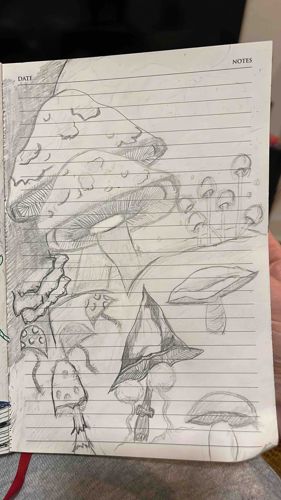
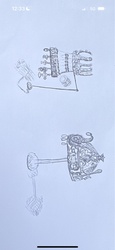
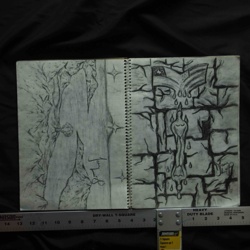
This item is a graphite pencil sketch depicting a variety of mushrooms, executed on a page from what appears to be a ruled journal or notebook. The sketch is rendered in grayscale using various shades of graphite, indicating different levels of pressure and possibly lead hardness. The composition features a large, dominant mushroom in the upper left, characterized by a broad, irregular cap with visible gill structures underneath and a textured surface suggesting spots or patches. To its right, a cluster of smaller, slender mushrooms extends upwards from the ground line, creating a sense of depth. In the lower and central areas of the page, several other distinct mushroom forms are observable, including one with a tall, conical cap resembling a witch's hat, and another with a spotted cap and a frilly or textured stem. The overall style is illustrative and somewhat fantastical, leaning towards a whimsical or fairytale aesthetic. The drawing is on a standard sheet of white or off-white paper, identified by uniform blue horizontal lines typical of ruled journal paper, and two faint vertical lines visible on the left side of the page. The words 'DATE' and 'NOTES' are printed in the upper left and upper right corners of the page, respectively, indicating its origins as a diary or journal entry. The sketch appears to be largely complete, with no obvious signs of damage such as tears or major smudges, though some minor graphite smudging is inherent to the medium. The craftsmanship suggests an amateur artist, focusing on form and texture with expressive lines and shading. The drawing is estimated to be contemporary in style, likely from the late 20th or early 21st century.
AI Appraisal Report
I have virtually examined this Mushroom-Themed Graphite Sketch in a Ruled Journal. The sketch is in a good, complete condition with no visible damage such as tears or significant creases, beyond the inherent minor graphite smudging typical of the medium. The ruled journal paper and printed headers ('DATE', 'NOTES') are consistent with a late 20th or early 21st-century origin, as suggested. Authenticity, based solely on visual inspection of the image, appears to be as described – an original graphite sketch. However, without physical examination, I cannot definitively confirm the age of the paper, the specific graphite medium used, or rule out advanced digital reproduction techniques.
The market for amateur or student-level graphite sketches, particularly those on common notebook paper, is generally limited. While the whimsical subject matter and illustrative style are charming, the execution suggests an amateur artist, which impacts its commercial value. Comparables would include other small, original amateur artworks or illustrations sold in local art fairs, online marketplaces for emerging artists, or novelty shops, rather than established fine art galleries. Demand for such pieces is typically driven by personal connection to the subject matter or appreciation for emerging talent, rather than investment potential. The piece is not rare given its contemporary style and amateur execution.
The primary factors impacting value are its original but amateur nature, the medium (graphite on ruled paper), and the lack of a known artist. For a full authentication, physical examination would be crucial to assess paper quality, graphite age, and detect any digital alterations. Provenance documentation (e.g., artist's signature, date, exhibition history) would significantly contribute to value if available.