AI estimate as of October 22, 2025 · verify with a professional before acting
AI-Generated · Verify before acting
Everything on this page is generated by AI for informational purposes only. AI can make mistakes — the AI may misidentify items or misattribute them (artist, maker, brand, designer, origin, era). This is not an official valuation and should not be used for insurance, sale, tax, estate, legal, or lending purposes — or any decision requiring a certified appraisal. It is not an authoritative claim about any person, brand, or rights holder — do not share or rely on it as a factual statement about a third party. Always consult qualified professionals before making financial decisions.
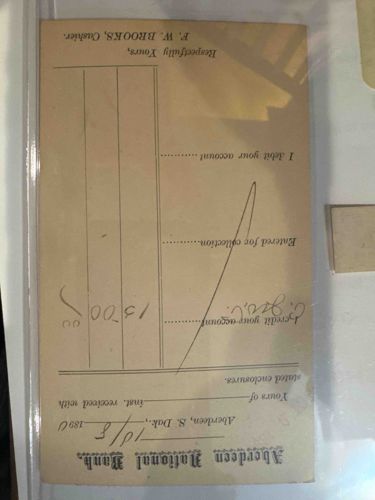
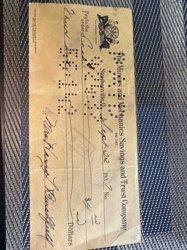
This item is an aged financial form, likely a deposit slip or an acknowledgment of receipt/transaction, from the 'Aberdeen National Bank' located in 'Aberdeen, S. Dak.'. The form is printed on what appears to be light brown or tan paper, exhibiting significant discoloration due to age, suggesting a style period of the late 19th century, specifically dated '10/8 1890'. The text 'Aberdeen National Bank.' is prominently displayed at the top in an ornate, possibly gothic or serif, font, indicating a formal and established institution. Below this, 'Aberdeen, S. Dak.,' confirms the bank's location. The form includes printed lines and sections for various banking transactions or notations, such as 'Yours of ______ inst. received with stated enclosures.', '____ credit your account.', 'Entered for collection...', and 'I debit your account...'. There is handwritten ink notation, notably '13.00' and '00' in a column, suggesting a monetary value. Another handwritten notation, 'GPC', is visible near the 'credit your account' line. The form concludes with 'Respectfully Yours, F. W. BROOKS, Cashier.' printed, indicating a formal closing from a bank official. The paper shows signs of wear consistent with its age, including potential foxing or slight discoloration variations, and it appears to be housed within a protective plastic sleeve, which is visible around its edges. The overall construction is simple, comprising a single sheet of printed paper, characteristic of bank stationery from that era. The ink used for the handwritten entries has faded slightly in some areas but remains legible. The quality of the paper and print appears standard for commercial banking documents of the period.
AI Appraisal Report
I have carefully examined the provided image of this Aberdeen National Bank form, dated October 8, 1890. The item appears to be an authentic financial form from the late 19th century, consistent with bank stationery of the period. The prominent institution name, location, and the printed signature of F. W. Brooks, Cashier, all lend credibility to its authenticity. The handwritten notations, particularly the monetary values and 'GPC', add a touch of historical personalization.
The condition, based solely on the image, is aged but generally acceptable for its 130+ years. The light brown/tan paper exhibits significant, yet consistent, discoloration and signs of wear typical of such an old paper document. Minor foxing or discoloration variations are visible. The ink for both printed and handwritten elements appears faded in areas but remains legible. The visible protective plastic sleeve is a positive indication that the item has been preserved.
From a market perspective, comparable items, such as late 19th-century bank forms or deposit slips from regional banks, typically see modest demand among ephemera collectors, local history enthusiasts, and exonumia collectors. While interesting, general bank forms are not exceedingly rare unless they are from particularly significant institutions, feature prominent historical figures, or are associated with notable events. This item, while a nice historical piece, primarily appeals to niche collectors interested in South Dakota banking history or general banking ephemera.
The main factors impacting its modest value are its common format as a basic correspondence or transaction slip and the lack of any unique elements that would elevate it above similar historical banking documents. Without specific provenance linking it to a major historical figure or event, its value remains in the realm of general historical ephemera. A physical examination would be crucial to definitively assess paper quality, true color, presence of watermarks, and the exact nature of any wear or repairs. Authentication of the 'F. W. Brooks' signature or confirmation if 'GPC' refers to a known individual would require further research or comparative exemplars, which are not possible from an image alone.