AI estimate as of July 16, 2025 · verify with a professional before acting
AI-Generated · Verify before acting
Everything on this page is generated by AI for informational purposes only. AI can make mistakes — the AI may misidentify items or misattribute them (artist, maker, brand, designer, origin, era). This is not an official valuation and should not be used for insurance, sale, tax, estate, legal, or lending purposes — or any decision requiring a certified appraisal. It is not an authoritative claim about any person, brand, or rights holder — do not share or rely on it as a factual statement about a third party. Always consult qualified professionals before making financial decisions.
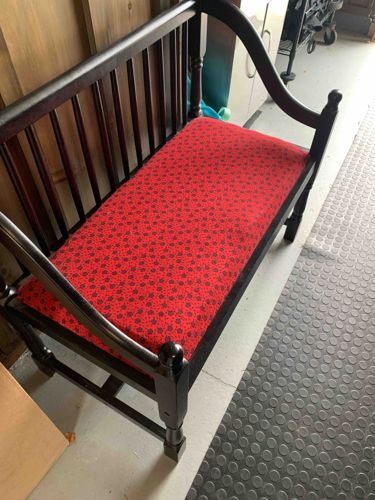
This item is a wooden settee or hall bench, characterized by its dark, possibly stained or ebonized, wood frame and a vibrant red upholstered seat cushion. The frame appears to be constructed from solid wood, featuring a rectangular seat and a slatted backrest composed of vertical spindles. The armrests present a graceful S-curve design, terminating in turned finials at the front. The legs are turned, with details suggesting a traditional or possibly Colonial Revival style, and they appear sturdy with square-section feet. The red upholstered seat is a notable feature, adorned with a repeating pattern of small, dark, possibly black or deep brown, floral or geometric motifs. The upholstery shows some signs of wear, including minor indentations or flattening of the cushion in areas, and a slight discoloration or fading might be present, though it largely retains its vivid hue. There are no readily visible manufacturer's marks or signatures in the provided image. The overall condition of the wood frame seems good, with a consistent dark finish, suggesting a well-maintained piece or perhaps a recent refinishing. The design elements, such as the turned legs and curved arms, point towards a style period that could range from the late 19th to early 20th century, or a reproduction of such. The craftsmanship appears solid and functional, consistent with household furniture of that era.
AI Appraisal Report
Upon my visual examination of the images provided, this upholstered wooden settee presents as a handsome example of late 19th or early 20th-century furniture, likely in the Colonial Revival or a related traditional style. The dark-stained wood frame, featuring turned legs, S-curved arms, and a spindled back, appears to be in good structural condition with a consistent finish, which may suggest a possible refinishing at some point in its history. The vibrant red patterned upholstery is a key aesthetic feature, though it exhibits signs of use, including minor indentations and potential slight fading. The primary value-driving factors here are its decorative appeal, functional size, and classic design. The market for such hall benches is relatively stable, with consistent demand for well-proportioned, decorative pieces. Comparable settees from this era, without a specific high-value maker attribution, typically sell in the secondary market based on their aesthetic and condition. The style is not particularly rare, but this example is well-executed. The most significant factor limiting its value is the lack of a known maker. Without a physical, in-person examination, it is impossible to definitively confirm its age, originality of the finish and upholstery, or identify any maker's marks, which would significantly impact its value. A physical inspection would allow me to check for construction techniques (e.g., joinery), signs of age on unexposed wood surfaces, and look for any labels or stamps. Without such verification, this appraisal is based on its decorative and functional qualities as a vintage piece.