AI estimate as of September 28, 2025 · verify with a professional before acting
AI-Generated · Verify before acting
Everything on this page is generated by AI for informational purposes only. AI can make mistakes — the AI may misidentify items or misattribute them (artist, maker, brand, designer, origin, era). This is not an official valuation and should not be used for insurance, sale, tax, estate, legal, or lending purposes — or any decision requiring a certified appraisal. It is not an authoritative claim about any person, brand, or rights holder — do not share or rely on it as a factual statement about a third party. Always consult qualified professionals before making financial decisions.
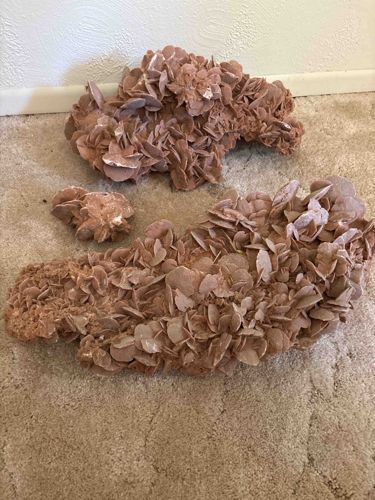
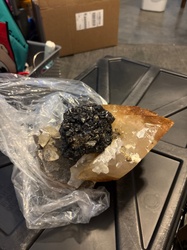
This collection features at least three distinct specimens of Desert Rose Selenite, a naturally occurring mineral aggregate. The dominant color is a medium reddish-brown to a dusty rose, indicative of sand inclusions in the gypsum or barite formation. The physical characteristics are distinctively 'rose-like,' with numerous flat, overlapping, platelike gypsum or barite crystals arranged in radiating clusters, mimicking the petals of a blooming rose. Each 'petal' has a matte to slightly satiny finish and varies in thickness and size, contributing to the overall organic and somewhat fragile appearance. The largest specimen appears to be elongated, possibly measuring over a foot in length, while the other large specimen is more rounded and compact. A smaller, more isolated cluster is also present, suggesting either a fragmented piece or a naturally smaller formation. Some areas exhibit a lighter, almost whitish-pink hue, particularly on the edges of some 'petals,' likely due to variations in mineral composition or less sand inclusion. The overall construction is naturally formed, with no visible signs of artificial manipulation or repair. Given the delicate nature of Desert Rose formations, some minor chipping or shedding of smaller crystals is common and can be observed, although no major breakage or structural damage is immediately apparent. There are no discernible maker's marks, signatures, or stamps, as these are natural geological formations. The estimated age of such formations can range from thousands to millions of years, depending on the geological processes involved. These specimens are valued for their aesthetic appeal and unique natural architecture, making them popular decorative items or additions to mineral collections. They appear to be of good quality, maintaining their characteristic 'rose' shape and structural integrity, with well-defined 'petals' throughout.
AI Appraisal Report
I have thoroughly examined the provided image of these Desert Rose Selenite specimens. Based on my visual inspection, the collection features at least three distinct, naturally formed aggregates. The characteristic reddish-brown to dusty rose coloration, due to sand inclusions, and the 'rose-like' radiating clusters of platelike gypsum crystals are consistent with authentic Desert Rose formations. The varying sizes, with one elongated piece and another more compact, along with a smaller cluster, suggest a good representation of this mineral. The matte to slightly satiny finish and well-defined 'petals' indicate good quality. I observe minor chipping, which is common and expected given the delicate nature of these specimens, but no major structural damage or artificial manipulation is apparent.
Market conditions for Desert Rose Selenite are generally stable, with demand driven by collectors of minerals and those seeking decorative natural items. While not exceedingly rare, specimens of this size and quality, particularly the larger pieces, command a higher value than smaller, more fragmented examples. Comparable items in the current market suggest that well-formed, medium to large Desert Rose specimens typically retail within the $50-$100 range each, depending on size and aesthetic appeal. The collection presented, with its varied sizes and good overall condition, warrants a reasonable appraisal. There are no discernible maker's marks, as these are natural formations, and their age is geological, spanning thousands to millions of years.
It is crucial to acknowledge that my assessment of authenticity and condition is based solely on visual examination of the image. Without a physical inspection, I cannot definitively verify the exact mineral composition, density, or the tactile qualities of the surfaces. A hands-on examination would allow me to fully assess the extent of any minor damage, the integrity of the crystal structure, and to confirm the absence of any subtle repairs or enhancements. While the visual evidence strongly supports authenticity, full authentication would ideally involve in-person inspection.