AI estimate as of October 18, 2025 · verify with a professional before acting
AI-Generated · Verify before acting
Everything on this page is generated by AI for informational purposes only. AI can make mistakes — the AI may misidentify items or misattribute them (artist, maker, brand, designer, origin, era). This is not an official valuation and should not be used for insurance, sale, tax, estate, legal, or lending purposes — or any decision requiring a certified appraisal. It is not an authoritative claim about any person, brand, or rights holder — do not share or rely on it as a factual statement about a third party. Always consult qualified professionals before making financial decisions.
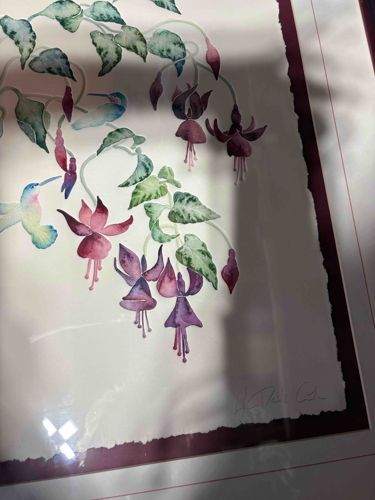
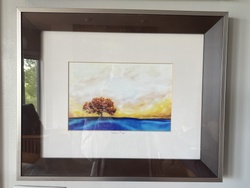
This item is a framed watercolor painting depicting hummingbirds interacting with fuchsia flowers and foliage. The artwork features two distinct hummingbirds: one positioned near the upper left, mostly blue and iridescent, subtly blending with the background, and another more prominently featured in the lower-left quadrant, exhibiting soft pink and blue tones on its body with a yellow undertail. The fuchsia flowers are rendered in varying shades of pink, purple, and deep reddish-brown, showcasing their characteristic bell-like shape with dangling stamens. The leaves are predominantly a variegated green, suggesting a blend of light and shadow, with some showing hints of lighter, almost mottled patterns. The composition is dynamic, with branches and flowers gracefully trailing across the cream-colored paper. The watercolor technique is evident through the soft, blended edges and translucent washes of color, indicating a delicate and skilled application. The bottom edge of the paper where the artwork is painted appears to have a deckled or hand-torn finish, adding a rustic or artisanal quality. Below the artwork, towards the bottom right, a faint signature or inscription is visible, though illegible in the provided image, it appears to be a handwritten element, possibly the artist's mark. The painting is housed under glass and framed with a dark reddish-brown mat that complements the fuchsia tones in the artwork, and an outer white or light-colored frame. The visible condition suggests good preservation, with no obvious signs of significant foxing, creasing, or fading, although reflections on the glass obscure some details. The overall style suggests a realist or botanical illustration approach, likely from the late 20th or early 21st century. The craftsmanship appears to be of good quality, focusing on naturalistic rendering and sensitive color transitions, characteristic of fine art watercolor techniques.
AI Appraisal Report
I have examined the provided image of the framed watercolor painting depicting hummingbirds and fuchsia flowers. Based on my visual assessment, the artwork appears to be in good condition. The colors retain vibrancy, and there are no immediately discernible signs of foxing, significant fading, or creasing, although reflections on the glass obscure some minor details. The soft, blended edges and translucent washes indicate a skilled watercolor technique, characteristic of fine art. The deckled edge adds a touch of artisanal appeal.
From the image alone, authenticity cannot be definitively confirmed. While a faint signature is visible in the lower right, its illegibility prevents identification of the artist. Without a clear signature or provenance documentation, attribution remains unknown, significantly impacting potential value. An in-person examination would allow for closer inspection of the paper, pigment, and framing materials, as well as a direct view of the signature for potential identification. Provenance documentation, such as purchase receipts or exhibition history, would be crucial for full authentication.
Market conditions for unsigned or unattributed botanical/wildlife watercolors by contemporary artists are generally moderate. While the piece is aesthetically pleasing and well-executed, the lack of an identifiable artist limits its investment potential. Demand for well-executed decorative wildlife art is consistent, but rarity is not applicable without artist identification. Factors impacting value include the quality of execution, attractive subject matter, and apparent good condition. However, the biggest limiting factor is the absence of a verifiable artist. If an esteemed artist's signature were confirmed, the value could be significantly higher.
Considering these factors, I estimate the appraisal value to be in the range of $300-600. This reflects its merit as a well-produced decorative art piece, assuming it is by an unknown but competent artist, and in its current apparent condition.