AI estimate as of October 4, 2025 · verify with a professional before acting
AI-Generated · Verify before acting
Everything on this page is generated by AI for informational purposes only. AI can make mistakes — the AI may misidentify items or misattribute them (artist, maker, brand, designer, origin, era). This is not an official valuation and should not be used for insurance, sale, tax, estate, legal, or lending purposes — or any decision requiring a certified appraisal. It is not an authoritative claim about any person, brand, or rights holder — do not share or rely on it as a factual statement about a third party. Always consult qualified professionals before making financial decisions.
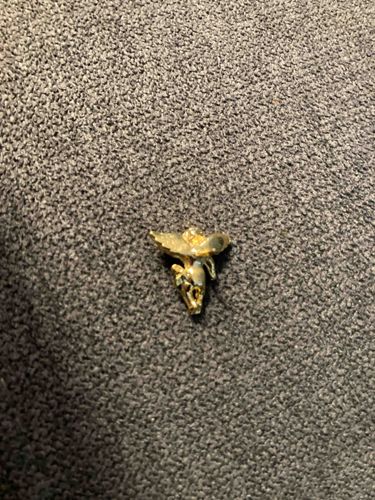
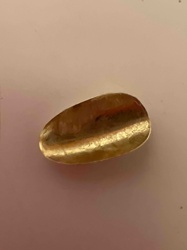
The item appears to be a fragment or a small, gold-toned ornamental piece, possibly part of a brooch or a decorative pin, shaped like an insect. Its overall color is a uniform metallic gold, suggesting it might be made of a gold-plated base metal, brass, or perhaps low-karat gold, though without closer inspection or hallmarks, definitive material identification is impossible. The form strongly resembles an insect with prominent wings, indicative of a fly, bee, or perhaps a stylized beetle. The body itself seems somewhat abstract but clearly conveys the impression of legs and a head segment. The wings are spread outward, adding to the insect-like silhouette. There appears to be a small, circular, possibly faceted stone or clear bead embedded near the 'head' or 'thorax' area, reflecting light and suggesting a sparkle. The craftsmanship, while appearing somewhat intricate in its insect depiction, is difficult to assess fully due to the image quality. There are no obvious maker's marks or signatures visible from the provided angle. The surface shows some signs of wear, particularly a slight dullness or minor tarnish in certain areas, consistent with age and handling. There are no clear indications of significant damage like breaks or large chips, but given its small size and potential as a fragment, some parts might be missing or broken off. The style leans towards a mid-20th century to contemporary costume jewelry aesthetic, though without further details, a precise age is hard to determine. Its small scale suggests it was likely intended as a subtle adornment.
AI Appraisal Report
Having examined the provided image of this gold-toned insect fragment, I assess its condition as fair to good. There's visible surface wear, including some dullness or tarnish consistent with age and handling, but no obvious breaks or major chips. Authenticity as a complete piece is questionable, as it appears to be a fragment. The uniform metallic gold tone suggests it's likely gold-plated base metal or brass, not solid high-karat gold, particularly given the estimated age and style consistent with costume jewelry from the mid-20th century onwards. The small, clear 'stone' is most likely glass or crystal. Without hallmarks or close-up inspection, definitive material identification and age confirmation are impossible. This item belongs to the broad category of decorative jewelry components or small accessories. The market for such fragments is generally low. Complete costume insect brooches from this era typically fetch $20-60, depending on design, condition, and maker. As a fragment, its value is significantly reduced, primarily to collectors or crafters who might repurpose it. Demand for such a specific fragment is very limited, making it fairly niche, but its specific rarity isn't a significant value driver due to its incomplete nature. Factors impacting value negatively include its status as a fragment, the likely base metal composition, and lack of identifying marks. To fully authenticate and accurately value this item, I would need a physical inspection to determine exact materials (e.g., gold content via XRF testing), construction, confirm if it is indeed a fragment or a complete miniature piece, and search for any hidden maker's marks or signatures. Provenance, if available, would also be beneficial.