AI estimate as of October 5, 2025 · verify with a professional before acting
AI-Generated · Verify before acting
Everything on this page is generated by AI for informational purposes only. AI can make mistakes — the AI may misidentify items or misattribute them (artist, maker, brand, designer, origin, era). This is not an official valuation and should not be used for insurance, sale, tax, estate, legal, or lending purposes — or any decision requiring a certified appraisal. It is not an authoritative claim about any person, brand, or rights holder — do not share or rely on it as a factual statement about a third party. Always consult qualified professionals before making financial decisions.
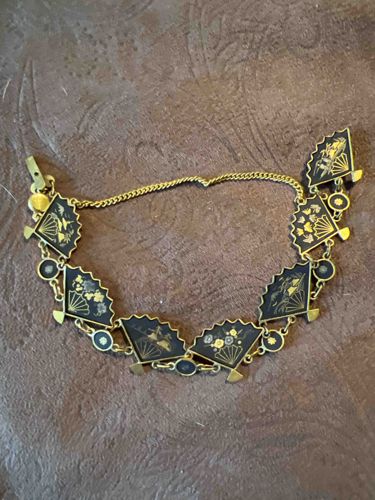
This exquisite piece is a bracelet composed of multiple interconnected fan-shaped links, indicative of Japanese damascene craftsmanship. The bracelet features eight distinct fan-shaped panels, each meticulously decorated with intricate gold and silver (or possibly other contrasting metal) inlays against a dark, likely blackened steel or alloy, background. The dark background provides a striking contrast to the metallic designs, which appear to depict natural motifs such as birds, flowers (like cherry blossoms or chrysanthemums), and possibly landscapes or architectural elements, characteristic of traditional Japanese art. Each fan link is framed by a thin gold-toned border, enhancing its distinct shape. Connecting these fan panels are smaller, circular links, also with a dark center and gold-toned rim, which serve to articulate the bracelet. The overall construction suggests a sequential assembly, allowing for flexibility when worn. The bracelet terminates in a gold-toned box clasp closure visible on one end. The metal appears to be a base metal, possibly brass or gilt base metal, given the overall tone and observed patina. The reverse side is not visible, but would likely show the backing of the damascene panels. The condition appears to be good with some signs of age-appropriate wear, such as slight tarnishing on the metal chain and possibly minor loss of inlay or surface scratching on the fan motifs, though these are not clearly discernible without closer inspection. This style of jewelry, particularly damascene work with Japanese motifs, was popular in the late 19th to early 20th century, especially during the Meiji period, and often produced for the export market. The craftsmanship, though not explicitly revealing a maker's mark, relies on precise inlay work, a hallmark of quality damascene pieces, making it a unique and culturally significant accessory.
AI Appraisal Report
Upon visual examination of this Japanese Damascene Fan Motif Bracelet, I assess it to be a fine example of export-ware, likely dating to the early 20th century, possibly the late Meiji or Taishō period. The construction features eight intricately inlaid fan-shaped panels depicting traditional Japanese motifs such as birds and florals, which is consistent with craftsmanship from this era. The condition appears good for its age, exhibiting some minor patina and potential surface wear, which is expected. The gold-toned finish on the base metal and the articulated links are characteristic of this style.
The market for Japanese damascene jewelry is relatively stable, with consistent interest from collectors of Asian antiques and vintage jewelry. Comparable bracelets in similar condition, featuring multiple detailed panels, typically sell in the low to mid-$100s at auction and online marketplaces. Demand is solid but not exceptionally high, which keeps values accessible. The primary value drivers for this piece are its detailed craftsmanship and decorative appeal. The lack of a visible maker's mark and the use of base metals, rather than precious metals, are significant factors that limit its value from reaching a higher tier.
Critically, this appraisal is based solely on images. Full authentication would require in-person examination to test the metals, confirm the inlay materials (e.g., gold, silver, or alloys), and search for any hidden maker's marks on the reverse or clasp. Without physical inspection, it is impossible to definitively rule out a later reproduction, though the stylistic elements strongly suggest an authentic period piece. Provenance documentation would, of course, add significant value if available.