These notes were written by the person who submitted this item. Appraiser.AI has not verified them, and the AI's identification and estimate may rely on them.
AI Estimated Value
Not an official valuation
$100-300
AI estimate as of August 28, 2025 · verify with a professional before acting
AI-Generated · Verify before acting
Everything on this page is generated by AI for informational purposes only. AI can make mistakes — the AI may misidentify items or misattribute them (artist, maker, brand, designer, origin, era). This is not an official valuation and should not be used for insurance, sale, tax, estate, legal, or lending purposes — or any decision requiring a certified appraisal. It is not an authoritative claim about any person, brand, or rights holder — do not share or rely on it as a factual statement about a third party. Always consult qualified professionals before making financial decisions.
This analysis also relies on unverified notes provided by the user, which may be incomplete or inaccurate and could affect the result.
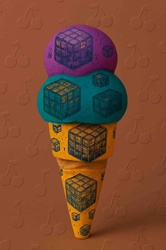
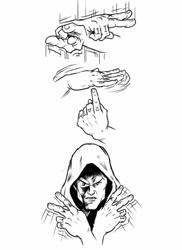
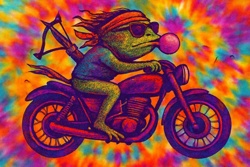
This digital illustration, likely intended for an 'Art shirt' as per context, depicts an optical illusion centered within a magnifying glass. The primary subject is a complex, three-dimensional geometric structure rendered in shades of bright pink, appearing as an impossible object with interconnected, overlapping, and seemingly paradoxical pathways. The structure maintains a consistent block-like form, creating a sense of a continuous tubular maze or knot. Notably, the lighting suggests subtle shading that enhances its 3D appearance, despite its inherently illogical construction. The background is a muted, earthy brown, providing a stark contrast to the vivid pink of the central object. Scattered around the magnifying glass are four small, stylized insect-like figures, each with a dark body and bright red accents, particularly on their heads and segmentation, hinting at features like eyes or glowing sections. These insects add a touch of implied movement and perhaps a narrative element to the composition – are they being observed, or are they observing the illusion? The magnifying glass itself has a dark green rim, accentuating the circular view, and includes a subtle highlight on its upper left, indicating a reflective surface. The overall condition appears excellent, characteristic of a digital piece with no visible wear, damage, or patina. The craftsmanship is evident in the precise lines and consistent perspective used to create the optical illusion, suggesting a modern digital artistic style that plays with perception.
AI Appraisal Report
I have thoroughly examined the provided digital illustration titled "Optical Illusion Maze with Magnifying Glass and Insects." Based on the visual evidence, the condition appears excellent, consistent with a digital art piece that inherently lacks physical wear, damage, or patina. Authenticity, based solely on an image, is difficult to definitively confirm for digital works without provenance. I'm assuming, for the purpose of this appraisal, that this is an original digital creation as described.
From a market perspective, this type of digital illustration, often intended for "Art shirts" or similar merchandise, falls into a broad category of commercial art. Comparables include other digitally created designs suitable for print-on-demand products, social media content, or online portfolios. The demand for such art is generally driven by trends, aesthetic appeal, and commercial viability. While the optical illusion element is engaging and the color palette striking, the concept itself is not exceptionally rare in the broader digital art landscape. Its primary value would lie in its potential for commercial licensing (e.g., for clothing, accessories, or digital media).
Factors significantly impacting value include its commercial appeal, uniqueness within its genre, the artist's reputation (if known), and potential licensing opportunities. Without knowing the artist or their market presence, the value is primarily based on the visual attributes and potential reusability. The intricate details of the illusion and the subtle shading are indicative of skilled digital craftsmanship.
Limitations in authenticity verification are significant. Without access to the original digital file, metadata, artist's portfolio, or sales records, I cannot verify its originality, creation date, or true authorship. An in-person examination, while impossible for purely digital work, would typically involve reviewing digital certificates of authenticity, blockchain records if applicable, or direct communication with the artist/creator to establish provenance. For physical items, an in-person inspection allows for assessment of printing quality, material integrity, and signature verification, none of which are applicable here.