AI estimate as of September 23, 2025 · verify with a professional before acting
AI-Generated · Verify before acting
Everything on this page is generated by AI for informational purposes only. AI can make mistakes — the AI may misidentify items or misattribute them (artist, maker, brand, designer, origin, era). This is not an official valuation and should not be used for insurance, sale, tax, estate, legal, or lending purposes — or any decision requiring a certified appraisal. It is not an authoritative claim about any person, brand, or rights holder — do not share or rely on it as a factual statement about a third party. Always consult qualified professionals before making financial decisions.
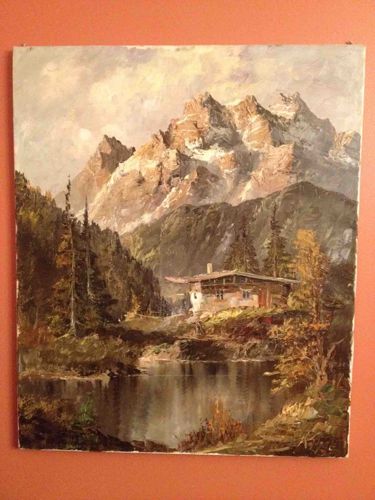
This item is an oil painting depicting an alpine landscape scene. The artwork features prominent, rugged mountains with snow-capped peaks in the background, rendered with varying shades of brown, grey, and white, suggesting a textural and somewhat impasto application of paint for the mountain faces. The sky above is a lighter, cloudy gray and white. In the mid-ground, a dense forest of dark green evergreen trees descends towards a body of water, likely a lake or wide river, which occupies the lower third to half of the canvas. The water reflects the surrounding trees and rocky terrain, showing muted greens, browns, and grays. On the right side of the painting, nestled among the trees by the water's edge, is a traditional European-style chalet or mountain house with a distinctive overhanging roof, white walls, and dark windows, possibly with red or brown accents. The foliage around the chalet and along the water's edge exhibits autumnal colors, with splashes of yellow, orange, and reddish-brown. The overall color palette is earthy and subdued, dominated by natural greens, browns, and grays with hints of white and lighter blues in the sky. The painting appears to be unframed, showing raw edges of the canvas, particularly in the lower left corner. There are no immediate visible artist's signatures or specific manufacturing marks from the provided image. The style suggests a 19th-century or early 20th-century European landscape tradition, perhaps from the Romanticism or Realism periods, focusing on natural beauty and sublime vistas. The condition appears to be fair to good, with some possible minor edge wear visible, consistent with an older unframed piece.
AI Appraisal Report
Upon visual examination of this Alpine Landscape Oil Painting with Lakeside Chalet, I assess its condition as fair to good. There appears to be some minor edge wear, particularly visible in the lower left corner, consistent with an unframed older piece. The color palette remains largely intact, suggesting good pigment stability. Authenticity, based solely on the image, suggests a European landscape tradition from the late 19th or early 20th century, aligning with Romanticism or Realism, though this is speculative without further evidence. The brushwork, while not clearly discernible in detail, suggests a competent hand.
Market conditions for unsigned landscape paintings of this genre are generally moderate. While charming, the lack of a discernible artist's signature significantly impacts its value. Comparable works by unknown artists in similar condition typically fall within a modest range. Demand for decorative landscapes remains steady, but rarity is low for unsigned pieces without a strong historical backstory. Factors significantly impacting value include the absence of an artist's signature, the lack of provenance, and the general decorative nature rather than fine art status.
It is crucial to note the limitations of authenticity verification from images alone. A definitive appraisal requires an in-person examination to assess the true condition, pigment composition under UV light, canvas type, and stretching method. Furthermore, comprehensive provenance documentation, detailing ownership history, would be critical for full authentication and to potentially link it to a known artist or school. Scientific testing, such as pigment analysis, could also confirm its age and materials. Without these, this remains a decorative landscape.