These notes were written by the person who submitted this item. Appraiser.AI has not verified them, and the AI's identification and estimate may rely on them.
AI Estimated Value
Not an official valuation
$250 - 450
AI estimate as of October 12, 2025 · verify with a professional before acting
AI-Generated · Verify before acting
Everything on this page is generated by AI for informational purposes only. AI can make mistakes — the AI may misidentify items or misattribute them (artist, maker, brand, designer, origin, era). This is not an official valuation and should not be used for insurance, sale, tax, estate, legal, or lending purposes — or any decision requiring a certified appraisal. It is not an authoritative claim about any person, brand, or rights holder — do not share or rely on it as a factual statement about a third party. Always consult qualified professionals before making financial decisions.
This analysis also relies on unverified notes provided by the user, which may be incomplete or inaccurate and could affect the result.
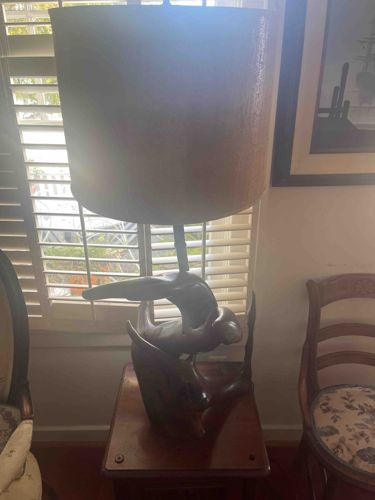
This is a unique custom table lamp featuring a base crafted from what appears to be a piece of natural wood, likely driftwood, given its organic, twisted, and weathered appearance, consistent with the provided context. The base exhibits rich, dark brown hues, possibly stained or naturally aged to a deep mahogany or walnut tone. Its form is highly sculptural, with intertwining and rising elements that suggest a natural water-worn origin, creating an abstract biomorphic shape that supports the lamp's central rod. There are no discernible maker's marks or signatures visible from the provided images, suggesting it could be a handcrafted, one-of-a-kind piece. The lamp's construction appears sturdy, with the central metal rod extending upwards from the wood base to support a drum-style lampshade. The lampshade is cylindrical, made of a textured, light-colored fabric or paper material, likely linen or a similar natural fiber, displaying a mottled or irregularly woven surface in shades of beige or light brown. The overall condition appears good, with no obvious signs of significant damage such as cracks, chips in the wood, or tears in the lampshade. The natural variations in the wood grain and texture are part of its appeal and not indicative of damage. The lamp exudes a rustic, organic, and potentially mid-century modern aesthetic, possibly dating from the mid to late 20th century, given the popularization of naturalistic and handcrafted decor during that period. The craftsmanship lies in the selection and integration of the natural wood piece into a functional light fixture, highlighting its intrinsic beauty.
AI Appraisal Report
I have carefully examined the provided images and description of this Driftwood Custom Table Lamp. Visually, the condition appears good; I note no significant damage like cracks or chips in the wood base, nor tears or major discoloration in the lampshade. The natural variations in the driftwood are inherent to its organic appeal and not defects. Authenticity as a 'custom' piece is strongly supported by its unique, sculptural form and lack of visible maker's marks, suggesting a handcrafted, one-of-a-kind origin.
Market comparables for similar handcrafted, organic, or mid-century modern-inspired lamps, particularly those utilizing natural wood or driftwood bases, range widely. Lamps of this nature often find a niche market among those seeking unique, artful home decor. The demand is present, particularly within bohemian, rustic, or eclectic interior design styles. Rarity is high due to its likely bespoke nature, which enhances its appeal as an individual piece rather than a mass-produced item. Factors impacting value positively include its distinct aesthetic and good condition. The natural, sculptural quality of the driftwood is its primary asset.
However, it's crucial to acknowledge the limitations of an appraisal based solely on images. While the piece appears authentic as described, I cannot definitively verify the type of wood, whether it’s naturally aged driftwood or sculpted and stained wood, nor can I confirm the structural integrity of the lamp's internal wiring without an in-person inspection. A physical examination would allow me to assess the quality of the electrical components, the stability of the wood base, and confirm the absence of hidden repairs or alterations. Provenance documentation, such as details about its creation or original acquisition, would further solidify its 'custom' status. Testing for wood type or age would require scientific methods not possible through images.