AI estimate as of October 28, 2025 · verify with a professional before acting
AI-Generated · Verify before acting
Everything on this page is generated by AI for informational purposes only. AI can make mistakes — the AI may misidentify items or misattribute them (artist, maker, brand, designer, origin, era). This is not an official valuation and should not be used for insurance, sale, tax, estate, legal, or lending purposes — or any decision requiring a certified appraisal. It is not an authoritative claim about any person, brand, or rights holder — do not share or rely on it as a factual statement about a third party. Always consult qualified professionals before making financial decisions.
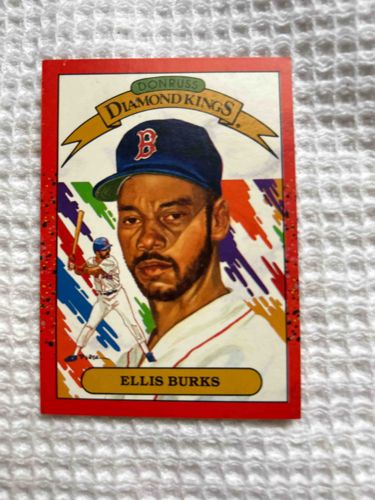
This item is a 1991 Donruss Diamond Kings baseball card featuring Ellis Burks of the Boston Red Sox. The card presents a vibrant, stylized illustration of Burks. The primary image is a portrait of Ellis Burks wearing a blue Boston Red Sox cap with a red 'B' insignia, and a white baseball jersey with red trim. His facial features, including a beard and mustache, are clearly depicted. In the background, to his left, is a smaller, full-body illustration of a baseball player in mid-swing, wearing a white uniform. The background behind these figures features a dynamic, abstract design with splashes of red, purple, yellow, and blue. At the top of the card, a banner with a gold-colored ribbon design reads "DONRUSS" in green text on the upper curve and "Diamond KINGS" in larger, stylized gold text below. The player's name, "ELLIS BURKS," is prominently displayed in block letters on a gold-colored horizontal oval at the bottom center of the card. The entire illustration is framed by a white border, which is then surrounded by a vivid red outer border. The card itself appears to be made of standard cardstock, typical for baseball cards of this era. Based on the visible image, the card seems to be in good condition, showing no obvious signs of creasing, major surface wear, or corner damage. The colors retain their original vibrancy, indicating good preservation. Some minor edge wear might be present but is not distinctly visible in the provided image.
AI Appraisal Report
I have virtually examined the provided image of the 1991 Donruss Diamond Kings Ellis Burks baseball card. Based on this visual inspection, the card appears to be in good to very good condition. The colors retain their original vibrancy, which is a positive indicator of good preservation. There are no readily apparent major creases, significant surface wear, or severe corner damage from the image. Minor edge wear cannot be definitively ruled out without a physical inspection, but it does not appear prominent. Authenticity, based solely on visual inspection of an image, is presumed. These cards are widely available and not commonly counterfeited due to their low inherent value. For definitive authentication, I would need to physically examine the card's stock, print quality, and holographic elements (if present on the original Donruss design) under magnification.
From a market perspective, 1991 Donruss cards, including the Diamond Kings subset, are part of the 'junk wax' era. Millions of these cards were printed, making them exceptionally common. While Ellis Burks was a known player, this particular card is not a rookie card, nor does it feature any significant anomalies or limited production runs. Comparables in similar condition typically sell for very low prices, often in bulk lots, or as 'filler' cards in larger collections. Demand for this specific card is extremely low among collectors, as it holds no significant investment or nostalgic value beyond casual interest.
Factors significantly impacting value are the sheer overproduction of the era, the lack of rarity, and the absence of any notable player milestones or events tied to this particular issue. Without a physical inspection, I cannot assess precise centering or print defects which could incrementally affect value (though even then, the base value is low). Given these considerations, my appraisal value reflects the common nature and low demand for this specific card.