AI estimate as of October 30, 2025 · verify with a professional before acting
AI-Generated · Verify before acting
Everything on this page is generated by AI for informational purposes only. AI can make mistakes — the AI may misidentify items or misattribute them (artist, maker, brand, designer, origin, era). This is not an official valuation and should not be used for insurance, sale, tax, estate, legal, or lending purposes — or any decision requiring a certified appraisal. It is not an authoritative claim about any person, brand, or rights holder — do not share or rely on it as a factual statement about a third party. Always consult qualified professionals before making financial decisions.
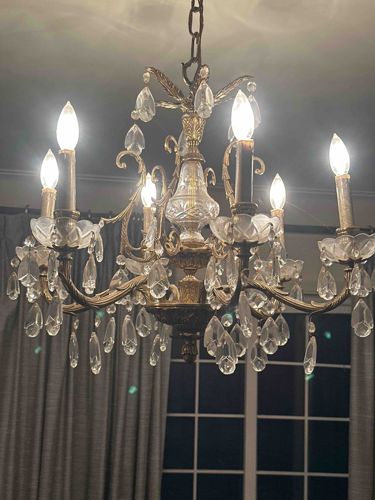
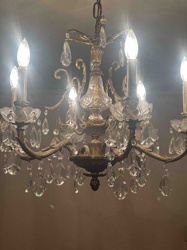
This is a vintage chandelier featuring a metallic (likely brass or bronze) frame adorned with numerous crystal elements. The chandelier is illuminated by six 'candle' style lightbulbs, indicative of its traditional design. The central column of the chandelier appears to be a combination of metal and cut glass, with a decorative faceted glass element prominently featured in the middle. The metallic frame exhibits an aged, possibly tarnished brass or bronze patina, suggesting considerable age. It features ornate, scroll-like arms that support the light sockets and also extend upwards to hold additional crystal drops. The crystal elements are primarily teardrop or icicle-shaped prisms, suspended from various points on the frame, including smaller, more delicate drops around the top and larger, more substantial ones around the lower perimeter. Some of the crystal bobeches (drip pans) below the candle-style lights also appear to be made of cut glass. The overall style points to a classical or perhaps Neoclassical influence, possibly dating from the early to mid-20th century. The craftsmanship, particularly in the detailed metalwork and cut crystal, suggests a piece of reasonable quality designed for interior decoration. No obvious manufacturing marks or significant damage like cracks or breaks are discernible from the image, but the metal shows a natural darkening and wear consistent with age and exposure. The chain linking the chandelier to the ceiling also has a similar aged metallic finish.
AI Appraisal Report
I have virtually examined this Vintage Crystal and Brass Chandelier. In terms of condition, visually, the piece appears to be in good vintage condition. The metallic frame exhibits a natural, aged patina, consistent with brass or bronze from the early to mid-20th century. This wear is desirable and authenticates its age rather than detracting from it. The crystal elements all appear intact without visible chips or cracks via these images. The overall aesthetic suggests authenticity as a period piece, aligning with classical or Neoclassical design influences. However, authenticating the type of crystal (e.g., lead crystal vs. glass), the exact metal composition, or confirming any manufacturer's marks is impossible from images alone.
Current market conditions for vintage lighting, especially chandeliers with crystal components, remain steady. Pieces with intricate detailing and good preservation tend to perform well. Comparable sales for similar six-light crystal and brass chandeliers, particularly those from the mid-20th century, typically range from $500 to $1,200 depending on the quality of the crystal, the intricacy of the metalwork, and the designer/manufacturer, if known. This chandelier's detailed ornamentation and seemingly complete crystal array contribute positively to its demand. Rarity is moderate; while not a unique designer piece, its preserved condition and classic styling make it a desirable item for period homes or collectors.
Factors significantly impacting its value include the presence of authentic cut crystal (which appears to be the case), the ornate brass/bronze frame, and the overall completeness. Were it a known designer piece, its value would significantly increase. Limitations in authentication from images alone are considerable. Full authentication would necessitate an in-person examination to verify crystal quality (e.g., lead content), inspect for hairline cracks or minor damage not visible, confirm metal composition, and thoroughly search for any maker's marks, which are crucial for provenance and definitive dating. Scientific testing could verify crystal type and metal alloys if needed for a higher-end valuation.