These notes were written by the person who submitted this item. Appraiser.AI has not verified them, and the AI's identification and estimate may rely on them.
AI Estimated Value
Not an official valuation
$4,000-7,000
AI estimate as of September 27, 2025 · verify with a professional before acting
AI-Generated · Verify before acting
Everything on this page is generated by AI for informational purposes only. AI can make mistakes — the AI may misidentify items or misattribute them (artist, maker, brand, designer, origin, era). This is not an official valuation and should not be used for insurance, sale, tax, estate, legal, or lending purposes — or any decision requiring a certified appraisal. It is not an authoritative claim about any person, brand, or rights holder — do not share or rely on it as a factual statement about a third party. Always consult qualified professionals before making financial decisions.
This analysis also relies on unverified notes provided by the user, which may be incomplete or inaccurate and could affect the result.
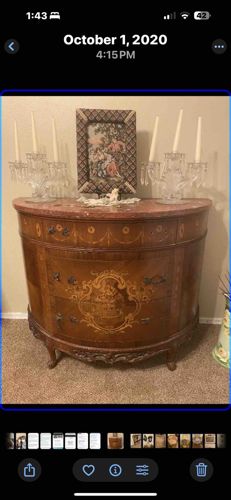
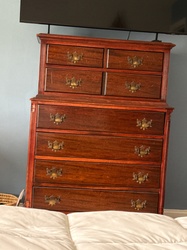
The item is a semi-circular commode, likely crafted from various types of wood, featuring extensive marquetry and a marble top. The commode exhibits a rich, warm brown wood tone with intricate inlaid wood patterns throughout its facade and sides. The top surface is a reddish-brown marble, possibly Rosso Levanto or similar, showcasing natural veining and a polished finish. The front of the commode curves outwards, and it appears to have multiple drawers, subtly integrated into the design. The most prominent feature is the large, central marquetry panel on the main body of the commode, depicting what appears to be an Rococo-style landscape or architectural scene, surrounded by ornate scrollwork and floral motifs. Above this central panel, a band of smaller, circular inlaid designs, possibly rosettes or small floral elements, runs along the top edge of the drawers. The hardware, consisting of small pulls or escutcheons, is dark and blends with the wood, indicating a subdued approach to drawer access. The commode stands on four splayed legs, with the front two exhibiting a more decorative, carved design, while the rear legs are simpler. A carved apron or skirt runs along the bottom edge between the legs, adding to its ornate appearance. There are visible signs of age and wear, including some possible fading or discoloration of the wood and marquetry, and minor scuffs or imperfections on the marble top. The overall aesthetic suggests an 18th or 19th-century European furniture style, possibly Louis XV or Louis XVI influenced, indicating a high level of craftsmanship and attention to detail common in such periods. The quality of the marquetry and the choice of materials point to a finely made piece of furniture intended for a prominent position.
AI Appraisal Report
Upon examining the provided image and description of this semi-circular commode, I am presented with a finely crafted piece of furniture exhibiting extensive marquetry and a marble top. The rich, warm wood tone and intricate inlaid patterns, particularly the Rococo-style landscape or architectural scene, speak to a high level of artistry. The reddish-brown marble top, likely Rosso Levanto, with its natural veining, complements the woodworking beautifully. The design elements, including the curved facade, subtly integrated drawers, and splayed legs, are consistent with 18th or 19th-century European furniture styles, specifically Louis XV or Louis XVI influences. The mention of its association with a 'Goblin tapestry' hints at a potentially sophisticated provenance, as 'Gobelins' tapestries were renowned and often paired with high-quality furnishings.
Condition-wise, the visible signs of age and wear such as possible fading, discoloration, and minor scuffs on the marble are expected for an antique of this nature and do not significantly detract from its value unless extensive. In fact, such signs often contribute to its authenticity and character. The quality of the marquetry craftsmanship is a primary driver of value. Given the detailed description, demand for well-preserved, period-style European commodes with intricate marquetry remains robust among collectors and interior designers seeking accent pieces.
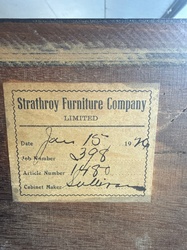
However, it is crucial to note the limitations of an appraisal based solely on images. While the visual evidence suggests authenticity and period style, a definitive authentication would require an in-person examination. This would allow for a thorough inspection of construction techniques, wood species identification, the quality and age of the internal drawer mechanisms, and the marble's underside. Examination under UV light could help reveal any repairs or restorations to the marquetry or finish. Provenance documentation, if available, such as original sales records or family histories, would significantly bolster its value by confirming its history and origin. Without these, the appraisal remains an informed estimate based on visual cues and typical market comparables for similar pieces. My valuation reflects its aesthetic appeal, apparent craftsmanship, and potential age, pending further verification.