AI estimate as of December 12, 2025 · verify with a professional before acting
AI-Generated · Verify before acting
Everything on this page is generated by AI for informational purposes only. AI can make mistakes — the AI may misidentify items or misattribute them (artist, maker, brand, designer, origin, era). This is not an official valuation and should not be used for insurance, sale, tax, estate, legal, or lending purposes — or any decision requiring a certified appraisal. It is not an authoritative claim about any person, brand, or rights holder — do not share or rely on it as a factual statement about a third party. Always consult qualified professionals before making financial decisions.
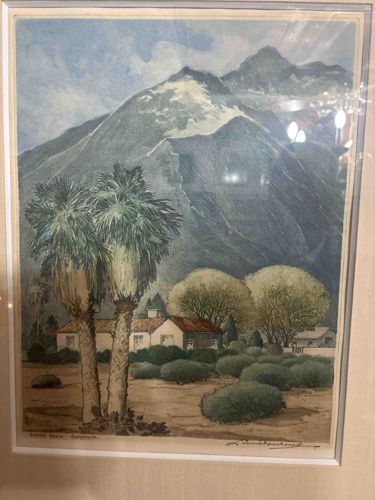
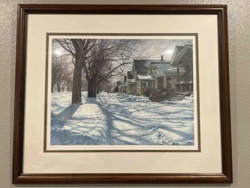
This item is a framed print or lithograph, likely a hand-colored etching or aquatint, depicting a serene desert landscape scene. The artwork is characterized by its muted earth tones, soft greens, and blues, which contribute to a tranquil atmosphere. In the foreground, two prominent palm trees with textured trunks and fronds dominate the left side, indicating a desert oasis setting. Behind them, several white-walled buildings with reddish-brown roofs are visible, suggesting Spanish Colonial Revival or Mediterranean architecture, common in California. The middle ground features extensive shrubbery and sparse ground cover in shades of green and brown. The background is dramatically defined by towering mountains, possibly snow-capped peaks, rendered in a textured blue-grey, suggesting a significant elevation. The sky above is a light blue with subtle cloud formations. The print itself is housed within a light-colored, possibly off-white or cream, mat and framed behind glass in a light-toned wooden frame. Visible at the bottom left is the title "Desert Oasis, California" and on the bottom right, a signature that appears to read "J. Vernon B. Broderick" or similar. Due to the reflection on the glass, discerning the exact medium and condition of the artwork beneath the glass is challenging, but no overt damage like tears or major discoloration is visible. The quality of the printing and potential hand-coloring suggests a fine art print. Based on the visible title and subject matter, the item likely dates from the mid-20th century, a popular period for regional landscape prints in California.
AI Appraisal Report
I have examined the image provided for this framed print titled "Desert Oasis, California." Based on the visual characteristics, it appears to be a hand-colored etching or aquatint, typical of regional landscape prints from the mid-20th century. The soft palette and detailed execution suggest a fine art print. The visible signature, appearing as "J. Vernon B. Broderick" or similar, would require further research to confirm the artist's identity and market presence.
From the image, the print seems to be in good condition, protected behind glass. No obvious tears, significant discoloration, or foxing are discernible, though reflections on the glass make a definitive assessment of the paper's condition and the artwork's surface challenging. The matting appears clean, and the light-toned wooden frame is period-appropriate and seems well-maintained.
Market conditions for regional landscape prints, particularly those from California’s mid-century, are generally stable. While not typically reaching high auction prices unless by a widely recognized artist, there is consistent demand among collectors of regional art and those seeking decorative pieces for homes in areas like Palm Springs. Comparables often fall into the $200-$500 range, depending on the artist's notoriety, edition size (if applicable), and overall condition.
The demand for this specific subject matter—a serene Desert Oasis in California—is likely strong within the local California market. However, without knowing the artist's full reputation or the print’s edition details, rarity is difficult to ascertain. Factors significantly impacting value include the confirmed identity and repute of the artist, whether it's a unique impression or part of a limited edition, and the actual physical condition of the print and its hand-coloring. The potential hand-coloring elevates it above a standard mechanical print.
My assessment of authenticity is limited to visual cues. For a full authentication, an in-person examination is crucial to verify the printing technique (etching, aquatint, etc.), confirm the hand-coloring, inspect the paper for watermarks or plate marks, and thoroughly assess the condition of the artwork beneath the glass. Provenance documentation, such as receipts or exhibition histories, would also be invaluable in confirming its authenticity and origin. Without these, my appraisal is based on the visible photographic representation and typical market trends for similar items.