AI estimate as of November 14, 2025 · verify with a professional before acting
AI-Generated · Verify before acting
Everything on this page is generated by AI for informational purposes only. AI can make mistakes — the AI may misidentify items or misattribute them (artist, maker, brand, designer, origin, era). This is not an official valuation and should not be used for insurance, sale, tax, estate, legal, or lending purposes — or any decision requiring a certified appraisal. It is not an authoritative claim about any person, brand, or rights holder — do not share or rely on it as a factual statement about a third party. Always consult qualified professionals before making financial decisions.
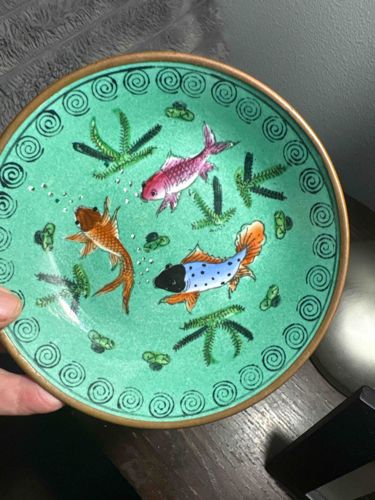
This appears to be a small decorative plate, likely made of enamel over metal, possibly copper, or a form of cloisonné. The plate features a vibrant aquatic scene set against a background of bright teal or turquoise green. The rim of the plate is a raised, polished gold or brass color, contrasting sharply with the main body. The design showcases three distinct fish: one predominantly pink, another orange with darker fins, and a third with a black head, light blue spotted body, and orange fins. These fish are dynamically positioned, swimming amidst various green aquatic plants, which resemble ferns or seaweed, and small green floating objects that could be lily pads or other flora. Bubbles are subtly indicated around the fish, adding to the underwater impression. A distinctive border encircles the inner edge of the plate, composed of repeating black spiral motifs against the teal background. The colors are vivid and appear to be applied with precision, suggesting fine craftsmanship. The surface has a smooth, glossy finish typical of enamelwork. There are no obvious signs of significant damage such as chips or cracks visible in the provided image, though minor wear consistent with age might be present upon closer inspection. The style suggests an East Asian origin, possibly Chinese, and could date from the mid-20th century or earlier, though without specific maker's marks, dating is an estimate. The overall quality appears good, with intricate detailing in the fish and plant life, demonstrating a skilled artisan's hand. The piece functions primarily as a decorative accent or collectible.
AI Appraisal Report
This enamel or cloisonné decorative plate, with its vibrant aquatic scene, appears to be in very good condition based on the provided image. I see no visible chips, cracks, or significant abrasions on the glossy surface, which is a key factor for enamelware. The colors remain vivid and the detailing precise, indicating good preservation. While the style strongly suggests an East Asian origin, likely Chinese, definitively authenticating its provenance and precise age (mid-20th century or earlier as estimated) from an image alone is challenging. Without physical examination, I cannot inspect the reverse for maker's marks, examine the construction methods, or assess the material quality of the metal base, which are crucial for full authentication.
Market conditions for decorative enamel plates of this type are generally moderate. While attractive and well-crafted, they are not exceedingly rare, and numerous similar pieces from various periods and origins are available. Demand is primarily from collectors of decorative arts and enthusiasts of Asian aesthetics. Comparable sales of similar-sized, good-condition decorative enamel or cloisonné plates without definitive high-end provenance typically fall within the $100-$300 range. Factors impacting value include the exceptional condition, detailed artistry, and attractive subject matter. However, the lack of definitive maker's marks, verifiable age, or documented provenance limits its upper market value. To fully authenticate its origin and age, a physical examination by a specialist is necessary, possibly including scientific testing of materials or enamel composition. Verifying provenance documentation, if any exists, would also be critical for higher valuation.