AI estimate as of July 12, 2025 · verify with a professional before acting
AI-Generated · Verify before acting
Everything on this page is generated by AI for informational purposes only. AI can make mistakes — the AI may misidentify items or misattribute them (artist, maker, brand, designer, origin, era). This is not an official valuation and should not be used for insurance, sale, tax, estate, legal, or lending purposes — or any decision requiring a certified appraisal. It is not an authoritative claim about any person, brand, or rights holder — do not share or rely on it as a factual statement about a third party. Always consult qualified professionals before making financial decisions.
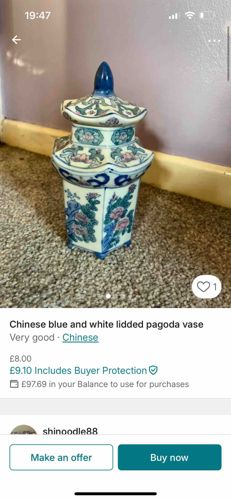
This item is a Chinese lidded pagoda vase, primarily featuring a blue and white color palette with additional pink and green floral accents. The vase has a distinctive tiered, pagoda-like form, consisting of a square or rectangular base body that tapers slightly, surmounted by a stepped, lidded top. The main body of the vase is adorned with detailed floral motifs, predominantly in shades of blue and pink, set against a light, possibly off-white, background. Each side of the body exhibits these floral patterns. The upper section of the vase, just below the lid, displays swirling blue patterns and possibly smaller floral or geometric designs. The lid itself is also decorated, mirroring the pagoda structure with multiple eaves, and is topped with a prominent, dark blue finial. The finial appears conical or steeple-shaped. The overall craftsmanship suggests a ceramic or porcelain material, likely hand-painted given the variation in brushwork. Visible condition appears to be very good, as suggested by the associated text, with no obvious chips, cracks, or significant wear detected from the image. The glaze appears to be intact and glossy. The style strongly points to a Chinese origin, likely 20th century, drawing inspiration from traditional porcelain forms and decorative techniques. The piece is a decorative item, intended for display rather than functional use as a typical vase for flowers.
AI Appraisal Report
Based on my visual examination of the provided image, this Chinese Blue and White Lidded Pagoda Vase appears to be in very good condition. The glaze is intact and glossy, and I detect no obvious chips, cracks, or significant wear. The detailed floral motifs in blue and pink, set against what appears to be an off-white background, along with the swirling blue patterns on the upper section, suggest a ceramic or porcelain material, likely hand-painted. The pagoda-like form and decoration are consistent with Chinese decorative arts.
From the image alone, authenticating the precise age and maker is challenging. While the style points to a Chinese origin, likely 20th century, a definitive assessment of authenticity would require in-person examination to inspect the base, production marks, and tactile qualities of the material. Provenance documentation, such as receipts or historical ownership records, would also significantly aid in verification. Scientific testing, like thermoluminescence dating, could provide a more precise age determination.
Market conditions for Chinese decorative ceramics, particularly those from the 20th century, are generally stable, with demand driven by decorative appeal more than historical significance for pieces of this nature. Comparables would include similar Chinese export or decorative porcelain pagoda vases from the mid to late 20th century. Rarity is not a significant factor here; while unique in its specific decoration, pagoda vases were a popular form. Factors impacting value positively include its very good condition and attractive, detailed decoration. Limitations: Without physical inspection, I cannot verify manufacturing quality minute details, or hidden damage. Authenticity and age remain estimates based on visual cues.
Given these considerations, this piece is primarily valued for its decorative qualities and condition.