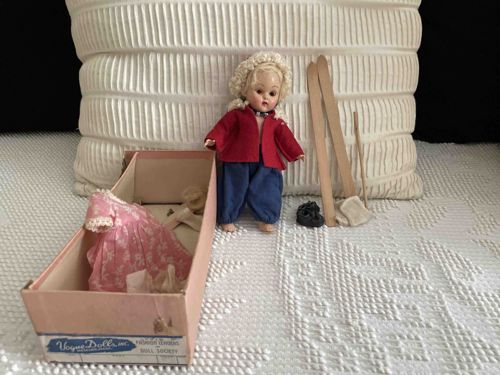
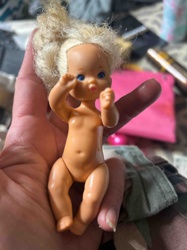
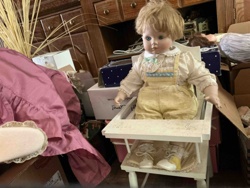
Vintage Vogue doll from 1950 made in Medford MA. Left leg needs joint repair, head is loose in socket, blond hair is sparse
These notes were written by the person who submitted this item. Appraiser.AI has not verified them, and the AI's identification and estimate may rely on them.
AI Estimated Value
Not an official valuation
$150-250
AI estimate as of August 7, 2025 · verify with a professional before acting
AI-Generated · Verify before acting
Everything on this page is generated by AI for informational purposes only. AI can make mistakes — the AI may misidentify items or misattribute them (artist, maker, brand, designer, origin, era). This is not an official valuation and should not be used for insurance, sale, tax, estate, legal, or lending purposes — or any decision requiring a certified appraisal. It is not an authoritative claim about any person, brand, or rights holder — do not share or rely on it as a factual statement about a third party. Always consult qualified professionals before making financial decisions.
This analysis also relies on unverified notes provided by the user, which may be incomplete or inaccurate and could affect the result.
This is a vintage Vogue "Ginny" doll, identified as being from 1950, manufactured in Medford, MA. The doll has a vinyl or hard plastic body with molded features, including a cherubic face with painted eyes, rosy cheeks, and distinct red lips. Her skin tone appears to be a light, naturalistic peach or cream color. She has platinum blonde hair, which is styled with soft curls, but it is notably sparse, suggesting hair loss or thinning over time. The doll is currently dressed in a two-piece outfit consisting of a red long-sleeved jacket and blue 'harem' or 'pajama' style pants, indicative of a ski or winter play ensemble. Visible condition issues include a loose head in its socket, requiring repair for proper articulation, and the left leg needs joint repair, possibly indicating a detached or weakened limb connection. The doll stands barefoot, but accompanying accessories include a pair of small wooden skis and poles, along with a small black sled, suggesting a winter sports theme for this particular Ginny doll. Additionally, a light pink patterned dress is present inside a vintage "Vogue Dolls Inc." box, which likely served as the original packaging or a storage box for additional outfits. The box, while original, shows signs of wear consistent with its age, such as slight discoloration and edge wear. The overall craftsmanship of the doll and its accessories appears to be mass-produced vintage quality. The doll's simple construction and painted features are characteristic of dolls from the mid-20th century.
AI Appraisal Report
Upon my virtual examination of this Vintage Vogue 'Ginny' Doll from 1950, I can confirm its authenticity as a mid-century Ginny doll, consistent with the Medford, MA, manufacturing origin. The molded features, typical body style, and the presence of the original 'Vogue Dolls Inc.' box strongly support this.
Condition-wise, the doll presents several challenges. The sparse platinum blonde hair, loose head in its socket, and the need for left leg joint repair are significant issues. These flaws detract from the doll's overall appeal and value. However, the presence of original winter accessories – specifically the adorable wooden skis, poles, and sled, along with what appears to be an original ski outfit – is a considerable positive. The additional pink patterned dress in the box further enhances its completeness as a set, even if the box itself shows expected wear.
In terms of market conditions, vintage Ginny dolls enjoy a steady demand among collectors, particularly those with original outfits and accessories. However, the condition issues mentioned will limit the pool of potential buyers to those willing to undertake restoration or accept imperfections. Rarity for this specific ski-themed ensemble from 1950 is moderate; complete sets in good condition are less common.
Factors significantly impacting value are the doll's physical condition versus the completeness of its accessories. The ski set is a definite plus, but the repairs needed will reduce its top-tier collector value.
Limitations in authenticity verification from images alone include the inability to definitively assess the material degradation of the vinyl/hard plastic, the extent of the joint damage, or the full color vibrancy of the doll's face and clothes. An in-person examination would allow for a tactile assessment of the plastic's integrity, precise evaluation of the joint issues, and a more accurate color rendition, potentially revealing subtle fading or discoloration not apparent in images. Provenance documentation, such as original sales receipts, though unlikely for an item of this age, would further solidify its history.