AI estimate as of November 22, 2025 · verify with a professional before acting
AI-Generated · Verify before acting
Everything on this page is generated by AI for informational purposes only. AI can make mistakes — the AI may misidentify items or misattribute them (artist, maker, brand, designer, origin, era). This is not an official valuation and should not be used for insurance, sale, tax, estate, legal, or lending purposes — or any decision requiring a certified appraisal. It is not an authoritative claim about any person, brand, or rights holder — do not share or rely on it as a factual statement about a third party. Always consult qualified professionals before making financial decisions.
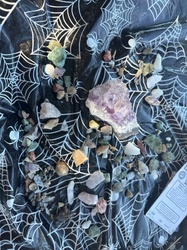
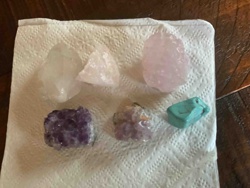
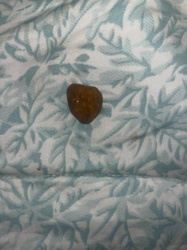
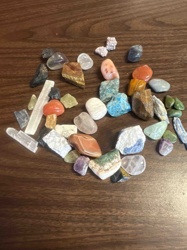
This collection consists of six individual gemstones, displaying a variety of colors, forms, and finishes. Three of the stones appear to be tumbled and polished, exhibiting smooth, rounded surfaces characteristic of this finishing technique, while two are more naturally 'raw' or minimally processed, retaining their crystalline forms. One stone is a translucent, cloudy white to light grey, suggesting a possible 'milky quartz' or similar variety, with a high polish and smooth, rounded edges. Another is a deep, rich indigo blue with white or lighter blue inclusions and veins, consistent with Sodalite, also highly polished and tumbled. A third tumbled stone is a mottled lavender and off-white or light grey, exhibiting a pleasing oval shape, potentially Lepidolite or a variegated form of Quartz such as Amethyst. In contrast, there is a distinct black stone with prominent vertical striations and a more rough, raw texture, indicative of Black Tourmaline (Schorl) in its natural columnar crystal form, which has not undergone tumbling. Another black, polished, and irregularly shaped stone could be Obsidian or Black Onyx, displaying a smooth, reflective surface. The sixth stone is fully translucent and colorless, with a clear, smooth, and tumbled finish, strongly suggesting Clear Quartz. The stones vary in size, generally appearing to be small enough to be held comfortably in the palm of a hand, likely ranging from approximately 1.5 cm to 4 cm in their longest dimension. No visible damage such as chips or significant scratches is evident on the tumbled stones, indicating good condition. The raw Tourmaline appears to be in its natural state. There are no discernible manufacturer's marks or signatures. The collection represents common forms of semi-precious stones, often sought after for their aesthetic appeal or perceived metaphysical properties. The combination of polished and raw specimens offers a contrast in textures and forms. The overall craftsmanship for the tumbled stones is of good quality, achieving a smooth, lustrous finish.
AI Appraisal Report
I have visually examined the provided image of the Assorted Tumbled and Raw Gemstones Collection. Based on this observation, the collection appears to consist of six semi-precious stones, including what I identify as Clear Quartz, Sodalite, a mottled lavender/white stone (possibly Lepidolite or variegated Quartz), Black Tourmaline (raw), Obsidian or Black Onyx (tumbled), and a milky/cloudy white quartz. The tumbled stones exhibit good finish with no visible chips or significant scratches, suggesting good condition. The raw Black Tourmaline appears in its natural crystalline form.
Authenticity, based solely on visual inspection from an image, is limited to general identification of common mineral types. Without direct physical examination, I cannot conclusively verify the specific mineral composition of each stone. For example, the mottled lavender stone could be Lepidolite, Charoite, or a form of Quartz, which impacts potential value. Similarly, distinguishing Obsidian from Black Onyx without a physical touch or specific gravity test is challenging.
Market conditions for such collections are typically driven by the aesthetic appeal and common availability of these semi-precious stones. They are widely available in rock shops, online retailers, and metaphysical supply stores. Demand is consistent but not high-end, primarily from hobbyists, collectors of common minerals, or those interested in their perceived metaphysical properties. Rarity is not a significant factor for these types and sizes of stones. The value is largely decorative or novelty rather than intrinsic gemstone value. The combination of tumbled and raw offers textural interest.
Factors significantly impacting value here are primarily the commonality of the stones. Had there been rare or significantly larger specimens, the valuation would differ. The biggest limitation in this appraisal is the lack of physical interaction, which prevents definitive identification through hardness testing, specific gravity measurement, or optical properties. To fully authenticate, I would require in-person examination to conduct these tests and ideally, provenance documentation would be beneficial, though unlikely for such common items.