AI Appraisal Estimate

AI-generated estimates · not official valuations

From the user

What was submitted

Photo and notes provided by the user — not generated by AI

Submitted item photo
Submitted photo · May 26, 2026

User's notes

No additional notes provided.

AI analysis below

AI appraisal

AI analysis & estimate

AI-Generated · Verify before acting

Everything below is generated by AI for informational purposes only. AI can make mistakes — the AI may misidentify items or misattribute them (artist, maker, brand, designer, origin, era). This is not an official valuation and should not be used for insurance, sale, tax, estate, legal, or lending purposes — or any decision requiring a certified appraisal. It is not an authoritative claim about any person, brand, or rights holder — do not share or rely on it as a factual statement about a third party. Always consult qualified professionals before making financial decisions.

Read the full disclaimer

AI Identification

·Not independently authenticated·Verify before acting

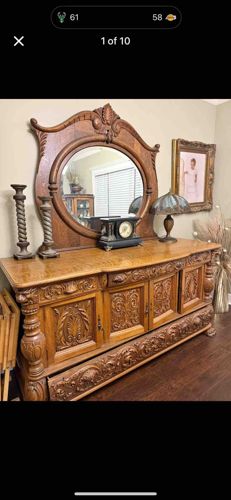
Victorian Renaissance Revival Influenced Carved Oak Sideboard with Circular Mirror

Antique Furniture

AI Estimated Value

·Not an official valuation·Verify before acting

$2,200-$3,500

As of May 26, 2026

AI Item Analysis

·AI can make mistakes·Verify before acting
This is a substantial and highly ornate sideboard crafted from quartersawn white oak, reflecting the late 19th-century Victorian aesthetic with strong Renaissance Revival influences. The piece features a prominent, circular beveled mirror set within an architectural splashback. This mirror is framed by heavy molding and topped with a central acanthus leaf and seed pod finial, flanked by scrolled 'ears'. The base unit is characterized by intensive hand-carved details, including deep relief scrolling acanthus leaves on the cabinet door panels and a central drawer. The structure is supported by four massive, bulbous turned legs with gadrooned ornamentation that terminate in block feet. A large, wide bottom drawer spans the length of the base, also featuring intricate foliate carvings. The wood exhibits a warm, honey-toned golden oak finish that highlights the characteristic 'flake' or 'tiger' grain patterns of quartersawn oak. While the piece appears to be in good overall condition, there is visible minor surface wear and a light patina consistent with an age of approximately 120-140 years. The craftsmanship suggests a high-end commercial manufacturer from the late 1880s to early 1900s, possibly from an American furniture hub like Grand Rapids, Michigan. The sheer scale and depth of the carvings indicate a premium piece intended for a formal dining room setting.
AI Appraisal Report

·AI can make mistakes·Verify before acting
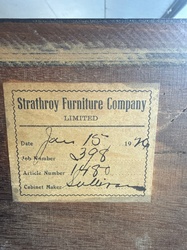
Based on my visual examination of the Victorian Renaissance Revival Influenced Sideboard, I find it to be an exceptional example of late 19th-century American furniture craftsmanship, likely originating from a high-end manufacturer in Grand Rapids, Michigan, circa 1890. The use of premium quartersawn white oak with prominent 'tiger' flake grain is highly desirable. The condition appears to be very good; while I note minor surface abrasions and a light patina consistent with a 130-year-old piece, the structural integrity of the massive bulbous turned legs and the clarity of the deep relief acanthus carvings remain sharp. The circular beveled mirror and architectural finial are characteristic of the high-style aesthetic of the era. Currently, the market for large-scale Victorian 'brown furniture' is specialized. While demand for massive formal dining pieces has softened compared to the 1990s, the rarity of the circular mirror configuration and the sheer quality of the hand-carved details sustain its value among serious collectors of the period. Factors enhancing value include the original honey-toned finish and the presence of any original hardware. However, value is significantly impacted by the piece's size, which requires a specific interior scale. Limitations to this digital appraisal include the inability to verify the joinery methods (such as drawer dovetails), examine the mirror's silvering for age-related foxing, or inspect the backboards for original maker's marks or labels. A full authentication would require an in-person inspection to confirm the wood's moisture content, analyze the finish under UV light for modern repairs, and review any provenance documentation to verify its historical chain of ownership.

Get your items appraised

Instant estimates of your treasures with AI-powered appraisals

Browse More Appraisals