AI estimate as of July 13, 2025 · verify with a professional before acting
AI-Generated · Verify before acting
Everything on this page is generated by AI for informational purposes only. AI can make mistakes — the AI may misidentify items or misattribute them (artist, maker, brand, designer, origin, era). This is not an official valuation and should not be used for insurance, sale, tax, estate, legal, or lending purposes — or any decision requiring a certified appraisal. It is not an authoritative claim about any person, brand, or rights holder — do not share or rely on it as a factual statement about a third party. Always consult qualified professionals before making financial decisions.
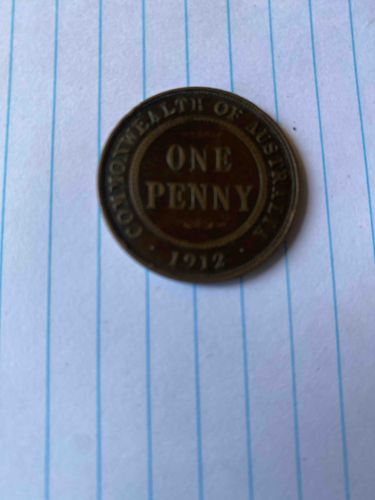
This item is an Australian One Penny coin, dated 1912. It is circular in shape and appears to be made of a bronze or copper alloy, consistent with coinage of that era, exhibiting a rich, dark brown patina that suggests significant age and handling. The obverse side, visible in the image, clearly displays the denomination ONE PENNY centrally within an inner circle. Encircling this inner design, along the rim, are the words "COMMONWEALTH OF AUSTRALIA" at the top, and the date "1912" prominently at the bottom. The lettering and numerals are raised, indicating a struck minting process. The surface shows moderate wear, particularly on the raised elements of the text and the inner circle's rim, which has softened the sharpness of the details. There are no obvious signs of severe damage such as deep scratches, bent edges, or significant corrosion, although minor surface abrasions common with circulated coins are present. The quality of craftsmanship is consistent with official government coinage, with a well-defined strike, though the details have been somewhat smoothed by circulation. The coin's color is uniform, suggesting natural toning rather than artificial alteration. Given its 1912 date, it belongs to the early 20th-century period of Australian coinage.
AI Appraisal Report
Upon examining the provided image of this Australian 1912 One Penny Coin, I can assess its condition and potential value. The coin appears authentic, consistent with known minting characteristics for the era, including the bronze/copper alloy and standard design elements. The "ONE PENNY" denomination, "COMMONWEALTH OF AUSTRALIA" inscription, and "1912" date are clearly discernible, indicating a genuine issue. The uniform dark brown patina suggests natural toning from age and circulation rather than artificial treatment.
Condition-wise, I observe moderate wear, particularly on the raised lettering and the inner circle's rim. Details have softened but remain legible. There are no signs of severe damage such as bends, significant corrosion, or deep scratches, though minor surface abrasions are present, common for a circulated coin of this age. This places the coin in the 'Good' to 'Very Good' circulated condition range (G-VG).
Demand for early Australian Commonwealth coinage, especially pre-King George V issues, is consistent among collectors. The 1912 One Penny is not considered a key date, with a relatively high mintage compared to some earlier or rarer years. However, its age and historical significance maintain steady collector interest. Factors impacting value include the degree of wear, the absence of significant damage, and the overall eye appeal, which this coin reasonably possesses for its grade.
Market comparables for 1912 Australian Pennies in G-VG condition typically range from low tens to mid-tens of dollars. Higher grades fetch significantly more, but this coin's wear prevents it from achieving those values. Conversely, heavily damaged examples would be worth less.
My primary limitation in this appraisal is the reliance on images alone. I cannot definitively verify authenticity without an in-person examination to check for exact weight, diameter, edge characteristics, and specific minting diagnostics that might reveal counterfeits. Chemical analysis (XRF) would confirm the alloy composition. Provenance documentation, if available, would also add to its authenticated history. Without physical inspection, I cannot rule out subtle alterations or extensive cleaning which may not be visible in the provided image.