AI estimate as of September 2, 2025 · verify with a professional before acting
AI-Generated · Verify before acting
Everything on this page is generated by AI for informational purposes only. AI can make mistakes — the AI may misidentify items or misattribute them (artist, maker, brand, designer, origin, era). This is not an official valuation and should not be used for insurance, sale, tax, estate, legal, or lending purposes — or any decision requiring a certified appraisal. It is not an authoritative claim about any person, brand, or rights holder — do not share or rely on it as a factual statement about a third party. Always consult qualified professionals before making financial decisions.
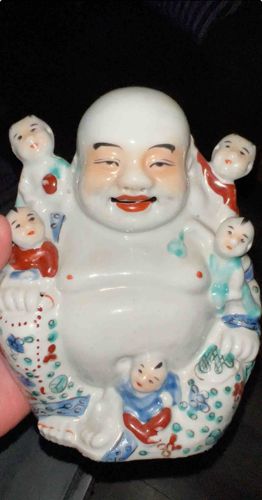
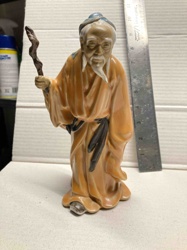
This is a ceramic figurine depicting Budai, often referred to as the 'Laughing Buddha', surrounded by several children. The figurine is made of glazed porcelain or ceramic, primarily white in color with detailed polychrome painting. Budai is shown with a large, bare belly, smiling broadly with rosy cheeks, red lips, and dark, slender eyebrows. His head is bald and smooth, characteristic of the 'Laughing Buddha'. The children, numbering at least five and possibly more, are playfully climbing on and around Budai. They are also depicted with distinct facial features and are dressed in garments painted in a variety of vibrant colors including red, blue, green, and orange. The base and lower portion of the figurine are adorned with an intricate, repeating pattern of small blue, red, and green floral or leaf motifs, suggesting auspiciousness or natural abundance. The craftsmanship appears to be of good quality, with attention paid to the expressive faces of both Budai and the children. There are no immediately obvious chips, cracks, or repairs visible, suggesting generally good condition. The glaze has a slight sheen, typical of porcelain figurines. Based on the style and typical manufacturing details, this piece likely dates from the mid to late 20th century, possibly a reproduction of an earlier Chinese export porcelain style. The presence of multiple children clinging to Budai is a common motif, symbolizing fertility, prosperity, and happiness. The exact size is not discernible without a reference object but it appears to be a medium-sized decorative item, likely intended for display on a shelf or table.
AI Appraisal Report
I have examined the provided image of this Porcelain Laughing Buddha (Budai) with Children figurine. Visually, the condition appears good; there are no immediately obvious chips, cracks, or repairs, and the glaze retains a good sheen. The polychrome painting is vibrant, and the details on both Budai and the children are well-executed. Based on the style, glazing, and general appearance, this figurine likely dates from the mid to late 20th century, consistent with Asian decorative exports of that period.
Market conditions for such contemporary decorative porcelain Buddha figures are moderate. While popular, these figurines are not rare, as many similar pieces were produced. Comparables from online marketplaces and auction results for similar 20th-century mass-produced decorative porcelain figures typically fall within this range. Demand is steady among collectors of Asian decorative arts or those seeking symbolic pieces for home decor, but it does not command high prices due to the volume of similar items available. The absence of a discernible maker's mark or artist signature significantly limits its value as a collectible antique, placing it firmly in the decorative object category.
A key limitation in this appraisal is the lack of physical examination. While the image suggests good condition, an in-person inspection would be necessary to confirm the absence of hairline cracks, unseen chips, or discreet repairs. Without physically handling the piece, I cannot verify the exact type of ceramic (porcelain vs. refined ceramic), the quality of the glaze, or the presence of any artist's marks or provenance details. Scientific testing would not typically be applied to a piece of this nature unless there were specific authenticity concerns for a high-value claim. Provenance documentation, such as original purchase receipts or family history, could potentially add value by confirming its age or origin, but is not typically expected for a decorative item of this market value.