AI Appraisal Estimate

AI-generated estimates · not official valuations

From the user

What was submitted

Photo and notes provided by the user — not generated by AI

Submitted item photo
Submitted photo · June 3, 2026

User's notes

Opal

AI analysis below

AI appraisal

AI analysis & estimate

AI-Generated · Verify before acting

Everything below is generated by AI for informational purposes only. AI can make mistakes — the AI may misidentify items or misattribute them (artist, maker, brand, designer, origin, era). This is not an official valuation and should not be used for insurance, sale, tax, estate, legal, or lending purposes — or any decision requiring a certified appraisal. It is not an authoritative claim about any person, brand, or rights holder — do not share or rely on it as a factual statement about a third party. Always consult qualified professionals before making financial decisions.

Note

This analysis also relies on unverified notes provided by the user, which may be incomplete or inaccurate and could affect the result.

Read the full disclaimer

AI Identification

·Not independently authenticated·Verify before acting

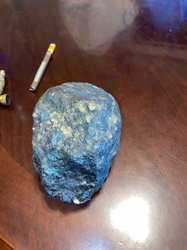
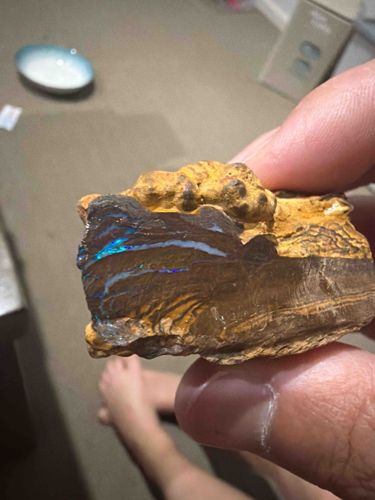
Rough Queensland Boulder Opal Specimen

Gems & Minerals

AI Estimated Value

·Not an official valuation·Verify before acting

$150 - $250

As of June 3, 2026

AI Item Analysis

·AI can make mistakes·Verify before acting
This specimen is a rough, unpolished Boulder Opal, characteristic of the mining regions in Queensland, Australia. The item consists of a dense, dark brown ironstone host rock matrix measuring approximately 4-6 centimeters in length. A distinct, thin undulating vein of precious opal is visible running horizontally through the ironstone. The play-of-color within this vein displays vibrant electric blue and cyan hues, which contrast sharply against the earthy, chocolate-brown tones of the matrix. The physical structure of the piece shows a raw, uneven surface with a botryoidal or 'bumpy' texture along the top ridge, exhibiting a mustard-yellow to ochre-colored clay or sandstone coating. The primary ironstone body shows natural sedimentary banding and a matte finish, indicating it is in its natural state post-extraction without significant lapidary work. Notable features include the high saturation of the blue 'fire' in the narrow opal seam, which suggests high-quality silica spheres within the vein. There is no evidence of fractures or 'crazing' (fine surface cracks) within the opal seam, which is a positive indicator of stability. This specimen represents a natural mineral formation that is millions of years old, typically harvested from Cretaceous period deposits. Its value is derived from the brightness of the color flash and the integrity of the ironstone host.
AI Appraisal Report

·AI can make mistakes·Verify before acting
I have carefully examined the provided images of this rough Queensland Boulder Opal specimen. The item appears to be an authentic specimen of ironstone-hosted precious opal typical of the Winton or Quilpie mining regions. The condition is rated as 'Excellent - Rough,' with no visible signs of crazing or internal fractures that often plague untreated opals. The primary value driver is the intense saturation of the electric blue and cyan flash within the horizontal vein, which exhibits high-grade brilliance even in an unpolished state. Market conditions for Australian Boulder Opal remain strong, as high-quality rough material is becoming increasingly scarce. While this piece is relatively small (4-6 cm), the stability of the ironstone matrix and the clarity of the opal seam make it desirable for mineral collectors or lapidary artists. However, the value is tempered by the thinness of the vein; until polished, the depth of the color bar cannot be fully determined, which introduces risk for a cutter. As this is a remote examination, I must note that authenticating the absence of host-rock enhancements or dyes is impossible without physical inspection under magnification. A full authentication would require polariscope testing to confirm the silica structure and a physical assessment of the 'bumpy' ochre surface to ensure it is natural sedimentary material rather than an applied paste. Provenance regarding the specific mine site would further bolster the appraisal accuracy.

Get your items appraised

Instant estimates of your treasures with AI-powered appraisals

Browse More Appraisals