These notes were written by the person who submitted this item. Appraiser.AI has not verified them, and the AI's identification and estimate may rely on them.
AI Estimated Value
Not an official valuation
$300-500
AI estimate as of August 10, 2025 · verify with a professional before acting
AI-Generated · Verify before acting
Everything on this page is generated by AI for informational purposes only. AI can make mistakes — the AI may misidentify items or misattribute them (artist, maker, brand, designer, origin, era). This is not an official valuation and should not be used for insurance, sale, tax, estate, legal, or lending purposes — or any decision requiring a certified appraisal. It is not an authoritative claim about any person, brand, or rights holder — do not share or rely on it as a factual statement about a third party. Always consult qualified professionals before making financial decisions.
This analysis also relies on unverified notes provided by the user, which may be incomplete or inaccurate and could affect the result.
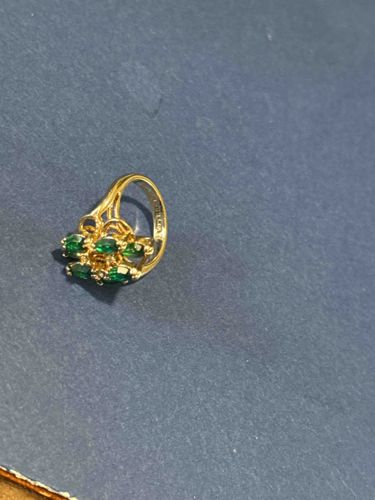
This item is a cluster ring, likely crafted from yellow gold based on its warm metallic hue. The ring's design features a central cluster of seven marquise-cut green gemstones, possibly emeralds or a similar gemstone, arranged in a floral or starburst pattern. Each of these green stones is individually set and appears to be prong-set, allowing light to access the facets. In the very center of the cluster, there seems to be a small round or brilliant-cut colorless stone, likely a diamond or a diamond simulant, which adds a contrasting sparkle. The ring's band is a classic smooth, polished gold, with a split shank design leading up to the gemstone cluster, providing sturdy support and enhancing the visual appeal of the setting. The visible portion of the band shows some reflective qualities and appears to be in good condition with no obvious signs of significant dents or deep scratches, though minor surface wear consistent with age and use may be present. The craftsmanship appears to be a standard jewelry manufacturing process, with the settings securely holding the stones. Without clearer images of hallmarkings, the exact gold karat or maker cannot be definitively identified, but the overall appearance suggests a quality piece of costume or fine jewelry from the mid to late 20th century. The green stones are vibrant and uniform in color, contributing to the ring's overall aesthetic.
AI Appraisal Report
Based on my visual examination of the provided image, this yellow gold cluster ring features seven marquise-cut green gemstones, likely peridots or tourmalines given the color saturation and common usage in similar vintage pieces, rather than emeralds which tend to command a higher value and often exhibit more inclusions. A small, round, colorless stone, appearing to be a diamond accent, is set at the center. The ring's setting is yellow gold, and while not determinable from the image alone, it likely ranges from 9K to 14K. The split shank design is classic for mid-to-late 20th-century jewelry. The overall condition appears good with minor surface wear consistent with age, but no apparent major damage.
Market conditions for vintage cluster rings, particularly those with vibrant colored gemstones, remain consistent. Comparables would include similar gold rings with peridot or tourmaline clusters and diamond accents. Demand for such pieces is moderate, appealing to those seeking antique or vintage-style jewelry. While not exceptionally rare, the unique cluster arrangement adds to its appeal.
Factors impacting value include the actual karat of gold, the specific type and quality of the green gemstones (verified through gemological testing), and the quality of the central diamond. If the green stones were indeed natural emeralds and the center a higher-quality diamond, the value would significantly increase.
Limitations: Without in-person examination, I cannot verify the gold karat, the precise identity or treatment of the gemstones, or the authenticity and quality of the central diamond. Hallmarking inspection, a jeweler's loupe, and gemological testing would be essential for full authentication and a more precise valuation. Provenance documentation, if available, would further enhance certainty.