AI estimate as of July 8, 2025 · verify with a professional before acting
AI-Generated · Verify before acting
Everything on this page is generated by AI for informational purposes only. AI can make mistakes — the AI may misidentify items or misattribute them (artist, maker, brand, designer, origin, era). This is not an official valuation and should not be used for insurance, sale, tax, estate, legal, or lending purposes — or any decision requiring a certified appraisal. It is not an authoritative claim about any person, brand, or rights holder — do not share or rely on it as a factual statement about a third party. Always consult qualified professionals before making financial decisions.
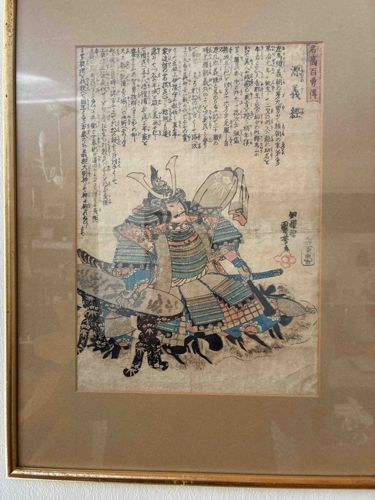
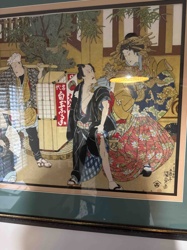
This item is an antique Japanese Ukiyo-e woodblock print, depicting a samurai warrior in full ceremonial armor, possibly engaged in a battle or a theatrical performance. The print is framed under glass, within a rustic, possibly wooden, light brown or tan frame with a golden inner rim. The overall dimensions appear to be consistent with a typical Ch
iban or Aiban size print, although exact measurements are not discernible from the image. The colors used in the print include a vibrant palette of blues, reds, black, and natural paper tones. The samurai's armor is intricately detailed with overlapping scales and textile patterns, showcasing the meticulous craftsmanship typical of Japanese woodblock printing. Distinguishing elements include the stylized helmet featuring prominent horns or crests, the layered segments of the armor, and the traditional facial features of the warrior. The top portion of the print contains extensive Japanese script, likely providing details about the scene, characters, or the artist. There are no clear visible maker's marks or signatures in the provided image, but the script itself may contain such information. Visible condition issues include a general mellowing or yellowing of the paper due to age, which is a common and often desirable patina for antique prints. There might be some subtle foxing or discoloration spots, particularly on the lighter areas of the paper, though this is difficult to confirm definitively given the image resolution and framing. The print appears to be well-preserved within its frame, suggesting it has been protected from direct handling damage. The quality of the lines and color registration, despite the age, indicates a high level of craftsmanship. Based on the style and subject matter, it likely dates from the Edo period (1603-1868) or Meiji period (1868-1912), making it an authentic piece of Japanese historical art.
AI Appraisal Report
Based on my visual examination of the provided image, this antique Japanese Ukiyo-e woodblock print depicting a samurai warrior appears to be an authentic example, likely dating from the Edo or early Meiji period. The intricate detail in the armor, the stylistic rendering of the warrior, and the extensive Japanese script are consistent with prints from these eras. The colors, while vibrant, show a natural mellowing indicative of age, and the paper exhibits a common, desirable yellowing patina. I do not observe any significant damage like tears or creases, suggesting it has been well-protected within its frame under glass.
From images alone, a definitive authenticity cannot be fully established. I note the absence of a visible maker's mark or signature in the photograph, though such information could be within the Japanese script. To verify authenticity completely and refine the dating, an in-person examination is crucial to identify subtle paper characteristics, printing techniques (e.g., wood grain showing through), and potential artist's seals or publisher marks that may be obscured or too small to discern digitally. Provenance documentation, such as previous ownership history or exhibition records, would significantly enhance its verifiable authenticity and value. Scientific testing, such as pigment analysis or paper fiber analysis, could further confirm its age and materials.
In terms of market conditions, Ukiyo-e prints, especially those of samurai subjects, maintain a steady and often robust demand among collectors. Samurai imagery is perennially popular, contributing to consistent interest. This particular piece, with its detailed depiction and apparent good preservation, would appeal to both seasoned collectors and new enthusiasts. While not overtly rare based on the subject matter alone, the specific artist, series, or historical context (if deciphered from the script) could elevate its rarity considerably. Comparables in the market for well-preserved Edo/Meiji period samurai prints of this apparent quality and size generally range from a few hundred to several thousand dollars, depending heavily on the artist's renown, the print's rarity, and its condition.
Factors significantly impacting value here include the apparent good condition given its age, the popular subject matter (samurai), and the visible artistic quality. The primary limitation from this image is the inability to identify the artist, the precise series, or subtle condition nuances like minor foxing that may affect value. If a prominent artist is identified, or if the print is part of a particularly sought-after series, its value could increase significantly.