These notes were written by the person who submitted this item. Appraiser.AI has not verified them, and the AI's identification and estimate may rely on them.
AI Estimated Value
Not an official valuation
$1,800 - $2,500
AI estimate as of July 18, 2025 · verify with a professional before acting
AI-Generated · Verify before acting
Everything on this page is generated by AI for informational purposes only. AI can make mistakes — the AI may misidentify items or misattribute them (artist, maker, brand, designer, origin, era). This is not an official valuation and should not be used for insurance, sale, tax, estate, legal, or lending purposes — or any decision requiring a certified appraisal. It is not an authoritative claim about any person, brand, or rights holder — do not share or rely on it as a factual statement about a third party. Always consult qualified professionals before making financial decisions.
This analysis also relies on unverified notes provided by the user, which may be incomplete or inaccurate and could affect the result.
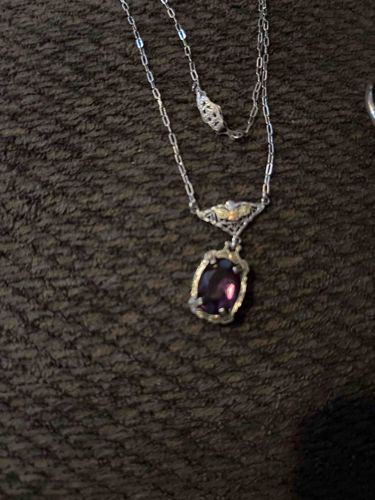
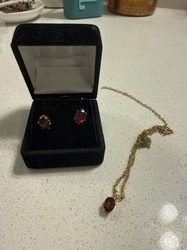
This exquisite antique necklace features a prominent oval-cut amethyst gemstone set in a silver-toned metal, likely white gold or platinum, given its age and quality appearance. The central amethyst exhibits a rich, deep purple hue with visible facets, suggesting good clarity and cut, although specific details are hard to ascertain from the image alone. The gemstone is enclosed within a bezel setting that appears to have an organic, somewhat irregular or 'nugget-like' texture, providing a unique, handcrafted aesthetic. Above the main pendant, there is an ornate filigree element, possibly depicting stylized wings or an architectural motif, with visible gold-toned accents that contrast beautifully with the silver metal. This suggests a bi-metal construction or applied gold leaf/plating, adding to its visual interest and craftsmanship. The pendant hangs from a delicate, elongated oval link chain, indicative of early 20th-century craftsmanship, specifically within the Art Deco or Edwardian periods, typically between 1900 and 1930. The chain itself appears well-maintained, with no obvious kinks or broken links. The overall condition seems very good for an antique piece, with a gentle patina on the metal that speaks to its age without significant signs of wear, major scratches, or damage.
Key features include the prominent amethyst, the intricate filigree work with gold accents, and the textured bezel setting. The craftsmanship appears to be of high quality, typical of fine antique jewelry. While no specific maker's marks are discernible from the image, the intricate details suggest it was produced by a skilled artisan. The chain's clasp is also filigreed, mirroring the pendant's design, which further enhances the piece's coherence and attention to detail. This style of necklace, characterized by elaborate metalwork and a central colored gemstone, was highly popular during its estimated period.
AI Appraisal Report
Upon examining the provided image and description of this Antique Amethyst and Filigree Pendant Necklace, I assess its condition to be very good for an antique piece of its age, likely early 20th century (1900-1930). The gentle patina suggests authenticity without significant wear or damage. The intricate filigree, 'nugget-like' textured bezel, and quality of the central amethyst speak to skilled craftsmanship typical of fine antique jewelry. The matching filigreed clasp on the elongated oval link chain further enhances its coherence and value.
Market conditions for antique jewelry, particularly Art Deco and Edwardian pieces with prominent gemstones, remain robust. Comparable pieces featuring similar quality amethyst and intricate metalwork can fetch significant prices. Demand for unique, well-preserved antique jewelry is consistently high, especially for items with historical charm and aesthetic appeal like this necklace. The apparent rarity lies in its distinctive bi-metal design and the handcrafted nature of the setting.
Factors significantly impacting value include the quality and size of the amethyst, the intricacy and condition of the metalwork (specifically the filigree and potential gold accents), and the overall preservation. The 'silver-toned metal' is likely platinum or white gold, which adds to its intrinsic value.
It is crucial to note the limitations of appraising from images alone. While the details suggest authenticity, physical examination is essential to confirm metal composition (e.g., precise gold/platinum content, presence of gold plating vs. solid gold accents), verify the amethyst's characteristics (treatment, exact clarity, and cut), and check for any repairs or signs of excessive wear not visible in the image. Authentication of maker's marks, if present, would require in-person inspection. Provenance documentation, if available, could further enhance its historical and market value.