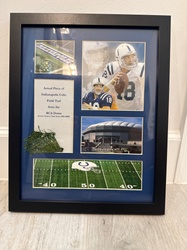
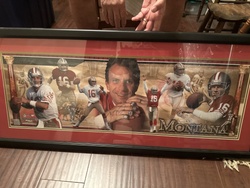
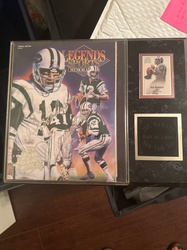
These notes were written by the person who submitted this item. Appraiser.AI has not verified them, and the AI's identification and estimate may rely on them.
AI Estimated Value
Not an official valuation
$3 - $8
AI estimate as of October 14, 2025 · verify with a professional before acting
AI-Generated · Verify before acting
Everything on this page is generated by AI for informational purposes only. AI can make mistakes — the AI may misidentify items or misattribute them (artist, maker, brand, designer, origin, era). This is not an official valuation and should not be used for insurance, sale, tax, estate, legal, or lending purposes — or any decision requiring a certified appraisal. It is not an authoritative claim about any person, brand, or rights holder — do not share or rely on it as a factual statement about a third party. Always consult qualified professionals before making financial decisions.
This analysis also relies on unverified notes provided by the user, which may be incomplete or inaccurate and could affect the result.
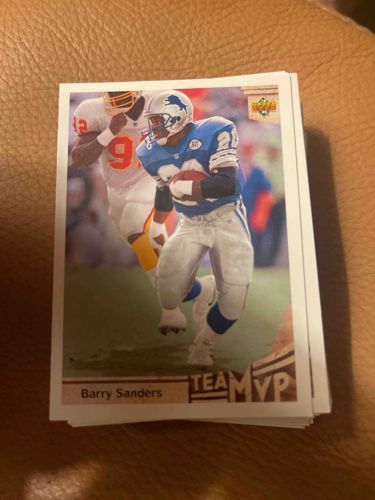
This item is a 1997 Upper Deck MVP football trading card featuring Barry Sanders, a legendary running back for the Detroit Lions. The card displays a dynamic action shot of Barry Sanders in his light blue Lions uniform, with the number 20 prominently visible on his jersey and helmet. He is shown mid-stride, holding a football, with another player, likely from the Tampa Bay Buccaneers given the red and white uniform, partially visible in the background. The card has a standard trading card size, typically around 2.5 by 3.5 inches, and is printed on glossy cardstock, common for sports trading cards of its era. Key identifying marks include the 'Upper Deck' logo in the upper right corner, a 'MVP' logo with 'TEAM' written diagonally below it in the bottom right, and 'Barry Sanders' printed in a horizontal bar at the bottom left. The borders of the card appear white, and from the provided image, the corners seem relatively sharp, indicating potentially good condition, though a full assessment would require viewing the back and all edges. Multiple cards are stacked, suggesting this might be part of a larger collection or set. The photographic quality on the card is consistent with late 1990s sports card releases, featuring good color saturation and detail in the action shot. There are no obvious major creases, tears, or significant surface abrasions visible in the image, although minor handling wear is possible on a card of this age. Its primary value would stem from its collectibility as a sports memorabilia item featuring a Hall of Fame player.
AI Appraisal Report
I have examined the provided image of the 1997 Upper Deck MVP Football Card featuring Barry Sanders. Visually, the card appears to be in relatively good condition for its age, with what seem to be sharp corners and no obvious major creases, tears, or surface abrasions visible in the photograph. The color saturation and detail are consistent with Upper Deck releases from the late 1990s. The 'Upper Deck' and 'MVP' logos, as well as the 'Barry Sanders' name, align with authentic cards from this set. Authenticity, based solely on this image, seems high for this particular card. However, without a physical examination, I cannot definitively confirm the absence of subtle surface wear, print defects, or minor edging issues that could impact grading.
Market conditions for this specific card are generally steady but low. The 1997 Upper Deck MVP set is a common issue, and while Barry Sanders is a highly collectible Hall of Famer, this is a base card, not a rare insert, parallel, or rookie card. Demand is present among Sanders collectors and Detroit Lions fans, but the supply in the market is abundant. Comparables for graded versions in PSA 9 or BGS 9.5 typically sell for $10-$20, while ungraded copies in excellent condition usually fetch between $3-$8. Factors significantly impacting value would be professional grading (PSA or BGS) leading to a high-grade assessment (9 or 10), which this card's visual condition suggests it *might* achieve. However, as an ungraded base card, its value remains modest.
Limitations in authenticity verification from images alone include the inability to inspect card thickness, surface texture for micro-scratches, or the exact centering on the reverse side. Full authentication and a precise condition assessment would require in-hand examination. Provenance documentation is not typically relevant for common modern trading cards of this type.