AI estimate as of December 15, 2025 · verify with a professional before acting
AI-Generated · Verify before acting
Everything on this page is generated by AI for informational purposes only. AI can make mistakes — the AI may misidentify items or misattribute them (artist, maker, brand, designer, origin, era). This is not an official valuation and should not be used for insurance, sale, tax, estate, legal, or lending purposes — or any decision requiring a certified appraisal. It is not an authoritative claim about any person, brand, or rights holder — do not share or rely on it as a factual statement about a third party. Always consult qualified professionals before making financial decisions.
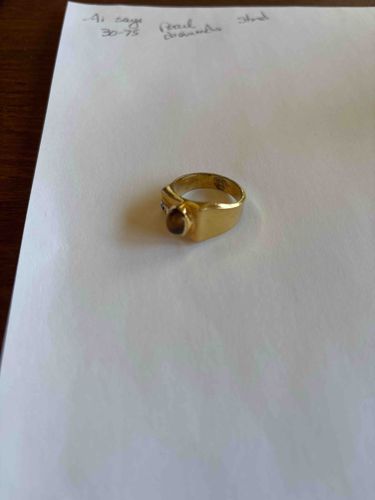
This item is a gold-toned ring featuring an oval-shaped, translucent cabochon stone. The ring appears to be constructed from a metal that mimics the color of gold, though the specific karat or metal composition is not discernible from the image. The band is relatively wide and has a polished, smooth finish, suggesting a substantial feel. The central stone is set in a bezel-like setting, which securely encircles its perimeter, rising slightly above the band. The stone itself displays a warm, brownish-orange hue, possibly indicating a gemstone such as tiger's eye, carnelian, or a type of quartz. Its cabochon cut emphasizes its smooth, rounded surface rather than facets. On one side of the central stone's setting, there appears to be a smaller, darker, possibly faceted stone, which could be an accent diamond or a dark gemstone. The overall style suggests a vintage or classic aesthetic, possibly dating from the mid-20th century to the present, leaning towards a more masculine or unisex design due to its robust band width. There are some visible signs of wear consistent with use, including minor surface scratches and possibly some light tarnishing or discoloration on the gold-toned metal, particularly on the inner band where a faint marking may be present (though unreadable). The craftsmanship appears to be solid, with the stone securely set, indicating a well-made piece, even if the materials are not of the highest intrinsic value. The visible wear patterns indicate that it has been worn and enjoyed.
AI Appraisal Report
Based on my visual examination of the provided image, I have appraised this gold-toned ring with an oval cabochon stone. The ring appears to be in good, worn condition, showing typical surface scratches and some minor discoloration consistent with regular use. The overall design suggests a vintage or classic aesthetic, with a robust band and secure bezel-like setting for the main stone. The gold-toned metal, while attractive, cannot be authenticated as solid gold from an image; it appears to be a gold-plated or gold-filled base metal. Authenticity of metal composition would require an in-person acid test or XRF analysis.
The main oval cabochon stone possesses a warm brownish-orange hue, characteristic of materials like tiger's eye, carnelian, or certain varieties of quartz. Without physical inspection and gemological testing, definitive identification is not possible. The smaller, darker accent stone's identity also remains uncertain; it could be a small diamond, onyx, or another dark gemstone. Its faceted cut suggests it's not a mere inclusion.
Considering market conditions for costume or vintage jewelry with unconfirmed material compositions, pieces in this style are generally accessible. Demand for such items is moderate, often appealing to collectors of vintage fashion or those seeking a statement piece without high intrinsic material value. The primary factors impacting value here are the unknown metal and stone compositions. Its value leans heavily on its aesthetic appeal and good craftsmanship rather than precious materials.
For full authentication of material composition, an in-person examination by a gemologist is essential, including refractometry for the main stone, specific gravity tests, and metal purity analysis (e.g., acid testing or XRF). Provenance documentation, such as original receipts or previous appraisals, would also significantly aid in authentication and value assessment. Without such verification, the appraisal primarily reflects its value as a well-made, aesthetically pleasing vintage-style piece rather than a fine jewelry item made of precious metals and gemstones.