AI Appraisal Estimate

AI-generated estimates · not official valuations

From the user

What was submitted

Photo and notes provided by the user — not generated by AI

Submitted item photo
Submitted photo · May 28, 2026

User's notes

No additional notes provided.

AI analysis below

AI appraisal

AI analysis & estimate

AI-Generated · Verify before acting

Everything below is generated by AI for informational purposes only. AI can make mistakes — the AI may misidentify items or misattribute them (artist, maker, brand, designer, origin, era). This is not an official valuation and should not be used for insurance, sale, tax, estate, legal, or lending purposes — or any decision requiring a certified appraisal. It is not an authoritative claim about any person, brand, or rights holder — do not share or rely on it as a factual statement about a third party. Always consult qualified professionals before making financial decisions.

Read the full disclaimer

AI Identification

·Not independently authenticated·Verify before acting

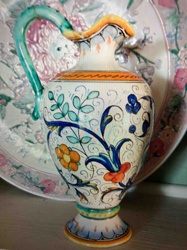
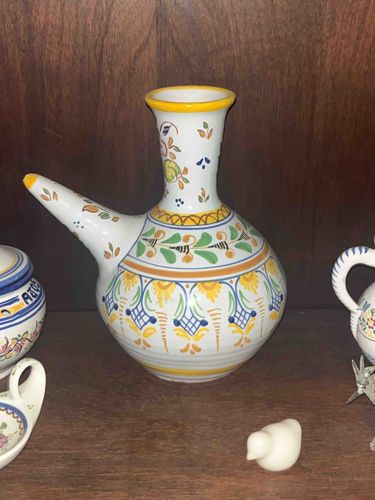
Deruta-Style Majolica Ceramic Botijo

Decorative Ceramics & Pottery

AI Estimated Value

·Not an official valuation·Verify before acting

$85.00 - $125.00

As of May 28, 2026

AI Item Analysis

·AI can make mistakes·Verify before acting
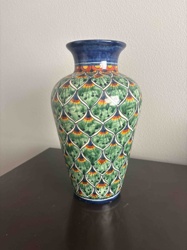
This item is a decorative ceramic water vessel, commonly known as a botijo or a specialized ewer, crafted in the tradition of Italian or Spanish tin-glazed earthenware (Majolica). The vessel features a bulbous, rounded body with a flared rim atop a slender neck and a prominent side spout designed for pouring or drinking. The piece is constructed from wheel-thrown terracotta covered in a milky white tin glaze. The decoration is hand-painted in a palette comprising ochre yellow, cadmium green, and cobalt blue, characteristic of Deruta or Talavera pottery styles. The midsection is adorned with a garland of stylized green leaves and ochre swirls, while the lower registers feature geometric cross-hatching and floral motifs. The condition appears excellent with no visible structural cracks or major chips, exhibiting a smooth, reflective glaze that suggests a mid-to-late 20th-century production date rather than an antique origin. The craftsmanship shows consistent line work and vibrant pigment application, indicative of a high-quality artisanal souvenir or decorative home accessory. Small dots of blue and green are scattered as accent fills, demonstrating traditional provincial folk art patterns.
AI Appraisal Report

·AI can make mistakes·Verify before acting
Upon my virtual examination of this Majolica botijo, I find it to be a charming example of late 20th-century decorative earthenware inspired by the Deruta tradition. The vessel displays a classic bulbous form with a characteristic side spout and ring handle. The glaze remains vibrant with a high-gloss finish, suggesting it has been used primarily for display rather than utility. The hand-painted scrolling foliage and geometric borders are executed with a steady hand, though the style is typical of high-quality workshop production ubiquitous in Italian and Spanish tourist centers from the 1970s through the 1990s. The condition appears excellent, with no notable crazing or chipping, which maintains its decorative value. In the current secondary market, such pieces are categorized as 'Decorative Collectibles' rather than 'Fine Antiques.' Similar mid-century Italian Majolica vessels frequently sell within the $75 to $150 range at auction or through specialized vintage retailers. Its value is driven by its aesthetic appeal as a colorful Mediterranean accent piece rather than its rarity. It is important to note that a definitive assessment of age and origin is limited by the digital nature of this inspection. This appraisal assumes the piece is free of professional restorations hidden by the glaze. For a full authentication, I would need to observe the unglazed foot-ring to check for the characteristic reddish-buff terracotta color and 'dry' texture of authentic Italian clay. A physical inspection would also verify the presence of a maker's mark or signature on the underside, which could marginally increase the value if from a documented workshop like Grazia or Sberna. Scientific testing is not recommended given the item's modern provincial nature.

Related Tags

Explore similar items and categories

Get your items appraised

Instant estimates of your treasures with AI-powered appraisals

Browse More Appraisals