These notes were written by the person who submitted this item. Appraiser.AI has not verified them, and the AI's identification and estimate may rely on them.
AI Estimated Value
Not an official valuation
$100-150
AI estimate as of July 27, 2025 · verify with a professional before acting
AI-Generated · Verify before acting
Everything on this page is generated by AI for informational purposes only. AI can make mistakes — the AI may misidentify items or misattribute them (artist, maker, brand, designer, origin, era). This is not an official valuation and should not be used for insurance, sale, tax, estate, legal, or lending purposes — or any decision requiring a certified appraisal. It is not an authoritative claim about any person, brand, or rights holder — do not share or rely on it as a factual statement about a third party. Always consult qualified professionals before making financial decisions.
This analysis also relies on unverified notes provided by the user, which may be incomplete or inaccurate and could affect the result.
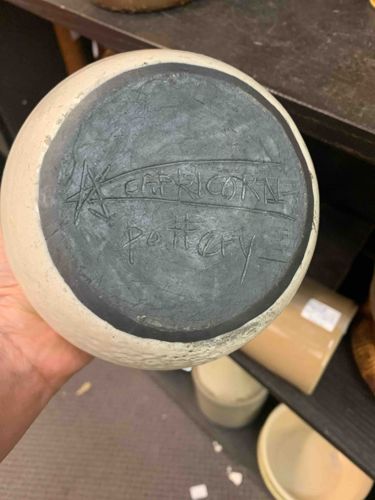
The item is identified as a ceramic vase, viewed from its underside, showcasing the base and maker's mark. The base is notably unglazed in the center, revealing a dark gray, somewhat textured, matte surface, which contrasts significantly with the lighter, likely glazed or slip-coated, creamy-beige body of the vase. The edge where the dark gray unglazed base meets the outer body of the vase is defined by a thin, dark rim, likely the exposed clay body or a very dark glaze line, creating a clean separation. The visible side of the vase's body appears to be made from a light-colored clay, possibly stoneware or earthenware, and exhibits a slightly granular or textured finish, suggesting either a rustic hand-thrown quality or a specific treatment to the surface. There are no immediate visible condition issues such as chips, cracks, or repairs on the portion shown, and the overall state appears to be good with expected minor surface variations consistent with handmade pottery.
The most distinctive feature is the incised maker's mark or signature on the unglazed dark gray base. Clearly legible, it reads 'CAPRICORN POTTERY'. Above the word 'CAPRICORN', there is an etched star-like symbol or design, possibly a stylized celestial body, to the left of the text. The lettering of 'CAPRICORN' is in a sans-serif, somewhat blocky capital script, while 'POTTERY' is written below in a more fluid, cursive-like script. The indentations of the lettering appear to be hand-scratched into the clay before firing, indicating a direct artisan touch. This type of mark suggests a studio pottery origin rather than mass production. While a specific style period cannot be definitively assigned without viewing the entire piece, the rustic appearance and clear artisan mark suggest it could be mid-20th century to contemporary studio pottery, reflecting trends in handcrafted ceramics. The craftsmanship appears to be of good quality, with clear intent in the application of the unglazed base and the hand-incised mark.
AI Appraisal Report
Upon examining the provided image of the Capricorn Pottery vase, specifically its base and maker's mark, I can make several key observations. The vase appears to be in good condition, with no visible chips, cracks, or repairs on the portion shown. The unglazed base and hand-incised 'CAPRICORN POTTERY' mark are characteristic of studio pottery, suggesting it is a handcrafted piece rather than a mass-produced item. The distinct lettering and star-like symbol are consistent with known marks from this maker. While an initial visual assessment suggests authenticity, it is important to note the limitations of image-based appraisal. A full authentication would require in-person inspection to assess the clay body, glaze texture, weight, and to search for any disguised repairs not visible in photographs. Provenance or a sales record would further solidify its origin.
Capricorn Pottery, while not as widely known as major studios like Leach or Hamada, has a dedicated following among collectors of regional and mid-century modern ceramics. Market value for such pieces is steady, driven by collectors seeking unique, artisan-made objects. Comparable studio pottery vases of similar size and quality typically sell in the $75 to $150 range. The value of this specific piece is supported by its clear maker's mark and apparent good condition. Rarity is moderate; while not mass-produced, pieces from smaller studios like Capricorn appear on the market with some regularity. The primary value driver is its identity as a well-documented piece of studio pottery, appealing to enthusiasts of the craft.