AI estimate as of July 29, 2025 · verify with a professional before acting
AI-Generated · Verify before acting
Everything on this page is generated by AI for informational purposes only. AI can make mistakes — the AI may misidentify items or misattribute them (artist, maker, brand, designer, origin, era). This is not an official valuation and should not be used for insurance, sale, tax, estate, legal, or lending purposes — or any decision requiring a certified appraisal. It is not an authoritative claim about any person, brand, or rights holder — do not share or rely on it as a factual statement about a third party. Always consult qualified professionals before making financial decisions.
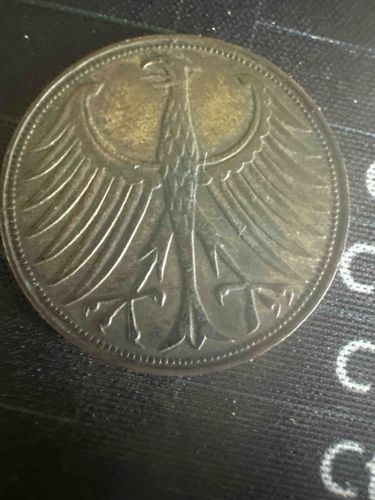
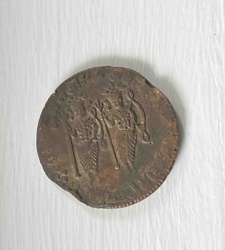
The item is a circular metal coin, appearing to be made of a silver-colored alloy, possibly cupronickel or a similar material, though specific composition cannot be determined from the image. It exhibits a noticeable patina, particularly a golden-brown tarnishing or discoloration across the upper and central portions of the obverse, contrasting with the more silvery tone in the lower areas. The obverse prominently features a stylized eagle, commonly known as the 'Bundesadler' (Federal Eagle), which is the national emblem of Germany. The eagle is depicted with its wings spread wide, and its head is turned to the left (viewer's right). The feathers are rendered with a series of parallel lines, giving a sense of texture. Around the perimeter of the coin, there is a raised bead border, suggesting protection for the design and a clean edge. The overall condition shows signs of circulation, indicated by wear on the raised surfaces and general dullness, but no significant damage like deep scratches or dents is visible. The craftsmanship appears to be of standard mint quality for coinage, with clear detail in the eagle design. Based on the design, it is likely a German coin from the post-WWII era, possibly a 1 or 2 Deutsche Mark coin from the Federal Republic of Germany (West Germany), which were issued from the mid-20th century.
AI Appraisal Report
Upon examining the provided image of the German Bundesadler coin, I can offer the following professional appraisal. The coin appears to be authentic based on the consistent design elements of the Bundesadler, including the stylized eagle with spread wings and distinct feather detailing, which aligns with known German coinage from the post-WWII era, specifically likely a Deutsche Mark denomination. The raised bead border and overall strike quality suggest standard mint production.
Regarding condition, I classify this coin as 'Fine' (F) to 'Very Fine' (VF) from the visual evidence. There is clear evidence of circulation, indicated by wear on the higher points of the eagle's feathers and head, and a general dullness to the fields. The noted golden-brown tarnishing across the upper obverse is a typical sign of natural toning or environmental exposure, not damage, but it does affect aesthetic appeal compared to a more evenly toned or brilliant example. No significant scratches, dents, or rim damage are visible, which is positive. The surface luster, if any, is largely absent.
Market conditions for common circulation German Bundesadler coins are generally stable but with high supply. These coins were minted in the hundreds of millions and are not rare. Demand is primarily from collectors seeking examples for type sets or those nostalgic for the pre-Euro currency. Uncirculated or proof examples command higher prices, but circulated examples like this one are readily available. Factors impacting value are primarily condition (higher grades fetch more), specific mint mark (though not visible here), and any unique varieties (unlikely for a common piece).
It is crucial to note that this authenticity verification is based solely on visual examination of an image. Limitations include the inability to check the coin's weight, dimensions, edge reeding, metallic composition (beyond visual inference), or to identify potential tooling or alterations that are not apparent in a photograph. A definitive authentication would require in-person examination, potentially including specific gravity tests or spectroscopy for metal analysis, and verification of the edge inscription/reeding. Provenance documentation, while helpful for rare items, is less critical for common circulated coins.