AI estimate as of July 6, 2025 · verify with a professional before acting
AI-Generated · Verify before acting
Everything on this page is generated by AI for informational purposes only. AI can make mistakes — the AI may misidentify items or misattribute them (artist, maker, brand, designer, origin, era). This is not an official valuation and should not be used for insurance, sale, tax, estate, legal, or lending purposes — or any decision requiring a certified appraisal. It is not an authoritative claim about any person, brand, or rights holder — do not share or rely on it as a factual statement about a third party. Always consult qualified professionals before making financial decisions.
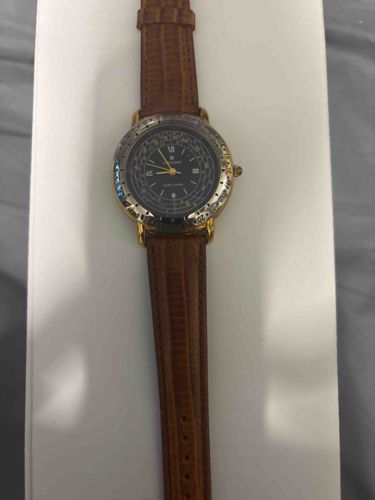
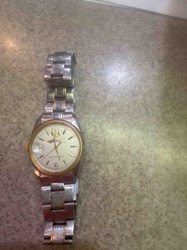
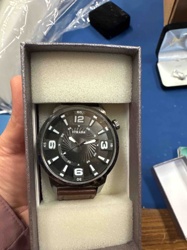
The item is a wristwatch, featuring a bi-metal design with a gold-tone case and a silver-tone bezel. The case appears to be round with a polished finish, showing some minor wear consistent with use. The bezel showcases an intricate, textured or engraved pattern, possibly with Roman numerals or decorative markers around its circumference, though specific details are difficult to discern from the image. The watch face is dark, likely black or dark blue, with gold-tone hands and what appears to be Roman numeral VI at the 6 o'clock position, and possibly Roman numeral XII at the 12 o'clock position. There are also smaller, possibly Arabic numerals or indices around the inner dial, suggesting a world time or city display complication, indicated by the 'WORLD TIMER' text on the dial. The crown, located on the right side of the case, is gold-toned. The watch is fitted with a brown leather strap that exhibits a croc-embossed or lizard-skin texture. The strap shows visible signs of wear, including creasing and possibly some darkening from age and use, particularly near the lugs and where it would typically buckle. The stitching along the edges of the strap appears even, suggesting reasonable quality. Overall, the watch presents a vintage aesthetic, likely dating from the late 20th century, possibly 1980s or 1990s, given the 'world timer' function and design elements. No apparent maker's marks or specific model numbers are visible in the provided image, precluding precise identification of the manufacturer.
AI Appraisal Report
Upon visual examination of this bi-metal world timer wristwatch, I note its vintage aesthetic, likely dating from the late 20th century. The watch features a gold-tone case coupled with a silver-tone, intricately textured bezel, suggesting a decorative rather than purely functional design element. The dark dial, gold-tone hands, and Roman numerals (VI, XII) are classic, while the 'WORLD TIMER' function and inner numerals indicate a more complex complication. The brown croc-embossed leather strap, though showing visible wear and creasing consistent with age and use, retains its original texture.
My assessment of condition, based solely on the provided image, is fair to good vintage condition. There is clear evidence of wear on both the case and strap, but no obvious significant damage like cracks or deep gouges. Authenticity, however, is a major limitation here. Without visible maker’s marks, hallmarks, or serial numbers, and a direct physical examination of the movement, I cannot definitively confirm authenticity or manufacturer. The presence of a 'world timer' function suggests a potentially more complex (and thus potentially more valuable) movement, but this cannot be verified visually.
In terms of market conditions, generic or unbranded vintage world timer watches typically command lower values unless they possess significant provenance or exceptional rarity. Comparables for unbranded bi-metal world timers in this condition are scarce due to the lack of specific identifying marks, but generally fall into the lower end of the vintage watch market. Demand for such items is niche, primarily appealing to collectors of vintage timepieces or those seeking a decorative accessory. The absence of a recognized brand significantly impacts value.
For full authentication and a more precise appraisal, an in-person examination is crucial. This would allow for inspection of the movement, verification of materials (e.g., whether the 'gold-tone' is plated, gold-filled, or solid gold), and a thorough search for any hidden maker's marks or serial numbers. Additionally, provenance documentation, if available, would significantly enhance its verifiable history and potentially its value. Without this, the appraisal remains speculative regarding its internal mechanics and ultimate origin.