Chert Lithic Core or Scraper Tool
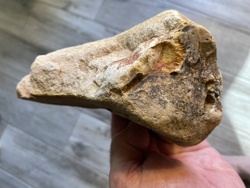
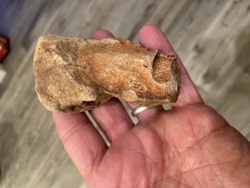
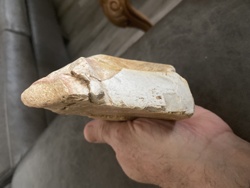
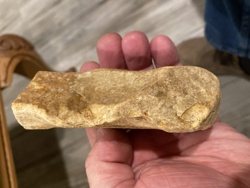
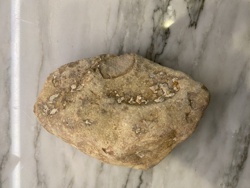
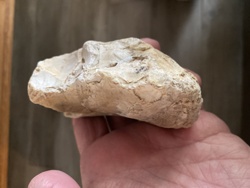
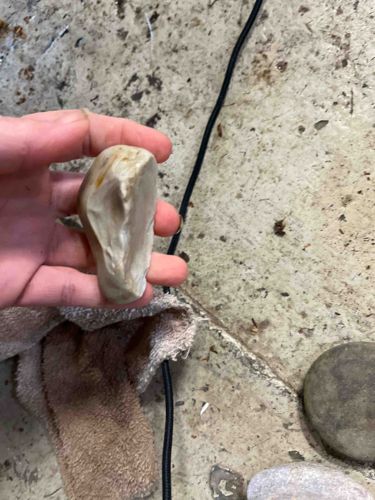
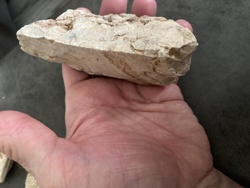
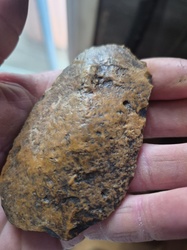
This item is a lithic artifact, likely a small core or a crude scraping tool made from a microcrystalline sedimentary rock, possibly chert or flint. Dimensionally, it measures approximately 2 to 2.5 inches in length, fitting easily within a human hand. The material exhibits a waxy luster and a range of neutral colorations from beige and tan to off-white, with a notable amber-colored inclusion near the top. The object displays clear evidence of conchoidal fracturing, featuring several negative flake scars where material has been intentionally removed through percussion. The surface shows a mix of smooth, water-worn cortex and sharper, more recent flake surfaces. Its shape is oblong and asymmetrical, with one thicker, rounded end and one narrower tapered end. In terms of condition, there is significant edge wear and some potential micro-flaking along the margins, which could indicate use-wear or post-depositional damage. There are no modern maker's marks or signatures, consistent with prehistoric lithic technology. Based on the crude reduction style, this could potentially date from the Archaic to Woodland periods, though without archaeological context, a precise age is difficult to determine. The craftsmanship is functional rather than aesthetic, representing an expedient tool used for tasks such as hide scraping or wood processing.
AI-Generated Appraisal Disclaimer
Estimated Value
$15 - $35
Basic Information
Category
Archaeological Artifact / Lithic Tool
Appraised On
April 7, 2026
Estimated Value
$15 - $35
Item Description
This item is a lithic artifact, likely a small core or a crude scraping tool made from a microcrystalline sedimentary rock, possibly chert or flint. Dimensionally, it measures approximately 2 to 2.5 inches in length, fitting easily within a human hand. The material exhibits a waxy luster and a range of neutral colorations from beige and tan to off-white, with a notable amber-colored inclusion near the top. The object displays clear evidence of conchoidal fracturing, featuring several negative flake scars where material has been intentionally removed through percussion. The surface shows a mix of smooth, water-worn cortex and sharper, more recent flake surfaces. Its shape is oblong and asymmetrical, with one thicker, rounded end and one narrower tapered end. In terms of condition, there is significant edge wear and some potential micro-flaking along the margins, which could indicate use-wear or post-depositional damage. There are no modern maker's marks or signatures, consistent with prehistoric lithic technology. Based on the crude reduction style, this could potentially date from the Archaic to Woodland periods, though without archaeological context, a precise age is difficult to determine. The craftsmanship is functional rather than aesthetic, representing an expedient tool used for tasks such as hide scraping or wood processing.
Get Your Items Appraised
Instant estimates of your treasures with AI-powered instant appraisals