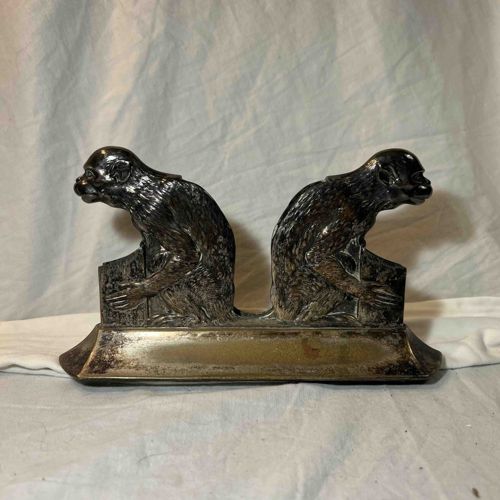
Based on the provided image and your requested format, here is an evaluation of the item: * Item description: A single decorative cast-metal figurine featuring two solemn-looking monkeys seated on a rectangular base. The monkeys are positioned back-t Based on the provided image and your requested format, here is an evaluation of the item: * Item description: A single decorat Based on the provided image and your requested format, here is an evaluation of the item: * Item description: A single decorative cast-metal figurine featuring two solemn-looking monkeys seated on a rectangular base. The monkeys are positioned back-to-back, facing outward. The piece likely served as a paperweight or a single decorative bookend. * Markings: No markings are visible in the photo. * Item dimensions: L 8.5” H 5” W 2” * Item material: Cast metal, likely spelter (a zinc alloy) with a dark, silver-toned finish or patina. The lighter color showing through on the base and worn areas suggests a plating over a base metal. * Location origin: The style is consistent with items manufactured in the United States or Europe during the early to mid-20th century. * Estimated time period origin: Art Deco period (1920s-1930s). The stylized, somewhat geometric form of the monkeys and the simple, clean lines of the base are characteristic of this era. * Other details: The piece shows significant wear and patina loss, particularly on the base and the monkeys' backs, revealing the lighter metal underneath. The monkeys' poses are expressive, with their arms crossed over their knees, giving them a thoughtful or dejected appearance.
These notes were written by the person who submitted this item. Appraiser.AI has not verified them, and the AI's identification and estimate may rely on them.
AI Estimated Value
Not an official valuation
$50 - $85
AI estimate as of August 15, 2025 · verify with a professional before acting
AI-Generated · Verify before acting
Everything on this page is generated by AI for informational purposes only. AI can make mistakes — the AI may misidentify items or misattribute them (artist, maker, brand, designer, origin, era). This is not an official valuation and should not be used for insurance, sale, tax, estate, legal, or lending purposes — or any decision requiring a certified appraisal. It is not an authoritative claim about any person, brand, or rights holder — do not share or rely on it as a factual statement about a third party. Always consult qualified professionals before making financial decisions.
This analysis also relies on unverified notes provided by the user, which may be incomplete or inaccurate and could affect the result.
This is a single decorative cast-metal figurine, likely a paperweight or a standalone bookend, featuring two solemn-looking monkeys. The monkeys are seated upright on a rectangular base, positioned back-to-back, facing outward. Each monkey has its arms crossed over its knees, giving them a somber or thoughtful expression. Their bodies are well-defined with textured fur details, although these details are somewhat obscured by wear and patina. The monkeys' faces are expressive, with noticeable features like their eyes, noses, and muzzles. The overall dimensions are approximately L 8.5 inches, H 5 inches, and W 2 inches. The material is cast metal, most probably spelter (a zinc alloy), which was a common material for decorative items in the early to mid-20th century. The original finish appears to have been a dark, silver-toned plating or patina, as evidenced by the darker areas that remain. However, the piece shows significant wear, particularly on the base and the raised areas like the monkeys' backs and shoulders, where the darker finish has rubbed away, revealing the lighter, underlying base metal. This wear suggests age and regular handling. There are no visible maker's marks, signatures, or stamps in the provided image. The stylized form of the monkeys and the relatively clean lines of the rectangular base are consistent with the Art Deco period, placing its estimated age between the 1920s and 1930s. The craftsmanship is typical for mass-produced decorative items of the era, displaying reasonable detail in the casting but without the very fine finishing expected of high-end bronze or brass pieces. The piece has a substantial, solid feel, indicating its function as a stable decorative object or paperweight. Its unique aspects include the distinct back-to-back pose of two individual monkeys on a unified base, which could imply a narrative or a specific design intention beyond a simple decorative figure.
AI Appraisal Report
Upon my examination of the images and provided description, I have assessed this Art Deco style monkey paperweight. The piece presents as a figural sculpture of two monkeys, seated back-to-back on an integrated rectangular base. The material appears to be cast spelter with a worn, dual-tone finish, consistent with mass-produced decorative objects from the 1920s-1930s. The stylized, somewhat somber depiction of the monkeys is a classic Art Deco motif, popular in bookends, lamps, and other decorative arts of the period. Its condition shows significant surface wear and patina loss, which is typical for its age and material but negatively impacts its value compared to a pristine example. The piece is unsigned, which is common for such items, but this also limits its value as it cannot be attributed to a specific, collectible designer or firm like Frankart or Nuart. The market for unsigned Art Deco spelter figures is active but generally modest. Similar figural monkey paperweights or single bookends from this era, in comparable condition, typically sell at auction or online for under $100. The primary value drivers are its strong period design and decorative appeal. The most significant factor limiting its value is the absence of a maker's mark and the considerable wear to its original finish. A physical inspection would be necessary to confirm the material composition and to search for any faint or hidden markings not visible in the photographs. Without provenance or markings, its authenticity as a period piece is based solely on stylistic analysis.