Wild Radish or Mustard Greens (Raphanus raphanistrum or Brassica spp.)
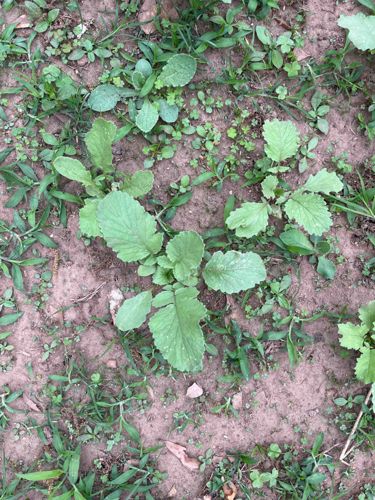
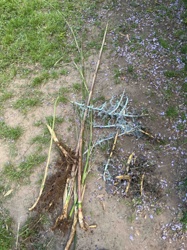
This image captures a cluster of young leafy herbaceous plants, most likely wild radish or a variety of mustard greens, growing in a naturalized or agricultural setting. The primary focal plant in the center-left displays a rosette growth pattern. The leaves are a vibrant medium-green color, featuring a lyrate-pinnatifid shape with a large rounded terminal lobe and smaller lateral lobes along the petiole. The margins are distinctly serrated or wavy, and the surface texture appears slightly rough or pubescent, which is a common characteristic of the Brassicaceae family. Smaller, similar specimens are scattered nearby, including one to the right and another toward the top. The surrounding environment consists of reddish-brown soil mixed with fine grit and smaller weed species, including common lawn grasses and clover-like foliage. There are minor signs of environmental stress, such as light spotting on some leaves which could indicate insect activity or moisture spray, but otherwise, the specimens appear healthy and in a vigorous vegetative state. The lack of flowers suggests these are early-season growth specimens, likely only a few weeks old since germination. The craftsmanship here is purely biological, demonstrating the resilient, hearty structure typical of forage or weed species found in disturbed soils across temperate regions.
AI-Generated Appraisal Disclaimer
Estimated Value
$0.00 - $5.00
Basic Information
Category
Botanical Specimens / Agricultural Plants
Appraised On
April 1, 2026
Estimated Value
$0.00 - $5.00
Item Description
This image captures a cluster of young leafy herbaceous plants, most likely wild radish or a variety of mustard greens, growing in a naturalized or agricultural setting. The primary focal plant in the center-left displays a rosette growth pattern. The leaves are a vibrant medium-green color, featuring a lyrate-pinnatifid shape with a large rounded terminal lobe and smaller lateral lobes along the petiole. The margins are distinctly serrated or wavy, and the surface texture appears slightly rough or pubescent, which is a common characteristic of the Brassicaceae family. Smaller, similar specimens are scattered nearby, including one to the right and another toward the top. The surrounding environment consists of reddish-brown soil mixed with fine grit and smaller weed species, including common lawn grasses and clover-like foliage. There are minor signs of environmental stress, such as light spotting on some leaves which could indicate insect activity or moisture spray, but otherwise, the specimens appear healthy and in a vigorous vegetative state. The lack of flowers suggests these are early-season growth specimens, likely only a few weeks old since germination. The craftsmanship here is purely biological, demonstrating the resilient, hearty structure typical of forage or weed species found in disturbed soils across temperate regions.
Get Your Items Appraised
Instant estimates of your treasures with AI-powered instant appraisals