These notes were written by the person who submitted this item. Appraiser.AI has not verified them, and the AI's identification and estimate may rely on them.
AI Estimated Value
Not an official valuation
$50-150
AI estimate as of September 22, 2025 · verify with a professional before acting
AI-Generated · Verify before acting
Everything on this page is generated by AI for informational purposes only. AI can make mistakes — the AI may misidentify items or misattribute them (artist, maker, brand, designer, origin, era). This is not an official valuation and should not be used for insurance, sale, tax, estate, legal, or lending purposes — or any decision requiring a certified appraisal. It is not an authoritative claim about any person, brand, or rights holder — do not share or rely on it as a factual statement about a third party. Always consult qualified professionals before making financial decisions.
This analysis also relies on unverified notes provided by the user, which may be incomplete or inaccurate and could affect the result.
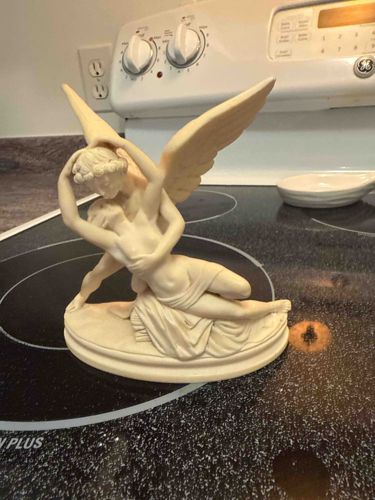
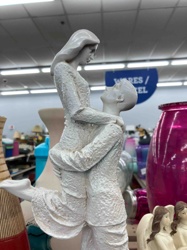
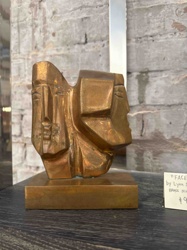
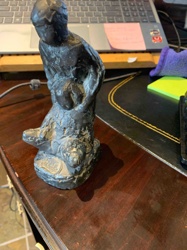
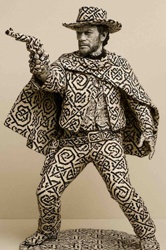
This item is a decorative sculpture depicting the classical mythological scene of Psyche Revived by Cupid's Kiss, closely mimicking the famous work by Antonio Canova. It features two intertwined figures: one winged, representing Cupid (Amor), embracing and leaning over a semi-reclined female figure, Psyche. The sculpture is crafted from what appears to be a light-colored, possibly off-white or cream-toned, cast material, such as resin, alabaster powder, or a synthetic composite, designed to emulate the look of marble or ivory as suggested by the user-provided context. The surface exhibits a smooth, matte finish with subtle variations in tone, common for cast reproductions. The construction is solid, likely a single piece mounted on an integral oval base. The details of the figures, including their anatomy, drapery, and hair, are rendered with a moderate degree of precision, showing defined musculature and flowing fabric folds. Cupid's wings are spread wide, providing a dynamic backdrop to the embrace. The condition appears to be good, with no obvious chips, cracks, or significant abrasions visible from the provided images. There is a clean, uniform coloration which suggests it is not a genuine ivory carving, as actual ivory would typically show a more distinct grain and possibly a deeper patina or discoloration over time, which often varies across the piece. The overall craftsmanship indicates a mass-produced or studio-produced decorative item, likely aiming for an antique or classical aesthetic. Without maker's marks or a signature, specific manufacturing details are indiscernible, but its style suggests a late 20th to early 21st-century reproduction of a Neoclassical artwork.
AI Appraisal Report
Upon examining the provided image and description of this 'Psyché Ranime Par Le Baiser De L'Amour' sculpture, it is clear that this is a decorative reproduction of Canova's famous work. The item appears to be in good condition, showing no visible chips, cracks, or significant wear. The smooth, uniform, light-colored surface, lacking the distinct grain and variable patina typical of genuine ivory, strongly indicates a cast material such as resin, alabaster powder cast, or a similar synthetic composite. The user's assertion of 'ivory carving' is inconsistent with visual evidence; genuine ivory would present noticeable growth lines, Schreger lines (cross-hatching pattern), and often a more aged, uneven coloration. Therefore, I can confidently state, even from images alone, that this is not an ivory carving.
Market conditions for such reproductions are generally modest. While beautifully crafted, these items are mass-produced or studio-produced, making them neither rare nor exceptionally coveted by serious collectors. Comparables on the secondary market, especially for well-executed resin or composite reproductions of classical sculptures, typically range from $50 to $150, depending on size, detail, and perceived quality. Demand is driven primarily by individuals seeking decorative accents for their homes rather than investment pieces. Factors significantly impacting value in this category are primarily the aesthetic appeal and condition.
Limitations in authenticity verification from images alone are significant regarding material composition. While I can strongly refute it being ivory, an in-person examination, potentially including a tactile assessment and close-up inspection under magnification, would be needed to definitively identify the exact casting material (e.g., distinguishing between resin and alabaster dust composite). Provenance documentation would be useful for specific manufacturing details or age, but is not typically available for such decorative items. Scientific testing, such as spectroscopy, would be required for a precise material analysis, though it's generally not cost-effective for items in this value range. The value provided reflects its status as a good quality modern reproduction.