AI estimate as of November 28, 2025 · verify with a professional before acting
AI-Generated · Verify before acting
Everything on this page is generated by AI for informational purposes only. AI can make mistakes — the AI may misidentify items or misattribute them (artist, maker, brand, designer, origin, era). This is not an official valuation and should not be used for insurance, sale, tax, estate, legal, or lending purposes — or any decision requiring a certified appraisal. It is not an authoritative claim about any person, brand, or rights holder — do not share or rely on it as a factual statement about a third party. Always consult qualified professionals before making financial decisions.
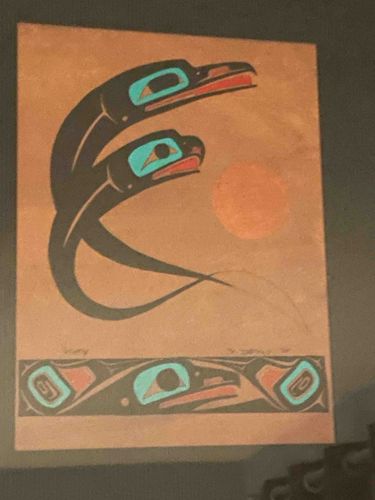
This item is an art print featuring a stylized depiction of two salmon, characteristic of Northwest Coast Indigenous art, likely Tlingit or Haida. The primary colors used are black for the main body of the fish, vibrant turquoise-blue for the eyes and internal forms, and a reddish-orange for accents on the mouths and fins. The background is a warm, earthy reddish-brown or terracotta hue, against which a circular reddish-orange shape, possibly representing the sun or moon, is visible in the upper right quadrant. The two salmon are rendered with flowing, curvilinear lines, interconnected and facing rightward, giving a sense of dynamic movement. Their forms are intricate, incorporating 'formline' elements such as ovoids and U-shapes. Below the main imagery, there is a decorative border with additional stylized motifs, also in black, turquoise, and reddish-orange, mirroring the aesthetic of the salmon. The print appears to be on a paper or board substrate, framed, though the frame itself is not clearly visible. The overall condition appears good, with no obvious major damage, tears, or significant discoloration visible from the provided image. The colors seem rich and unfaded, suggesting good preservation. In the lower left, faint signatures or numbering are present, '55/100' is visible, indicating it's a limited edition print, further suggesting it's a serigraph or lithograph rather than an original painting. The craftsmanship reflects the distinct cultural art tradition of the Pacific Northwest Coast Indigenous peoples.
AI Appraisal Report
I have examined the image of this Tlingit-Style Salmon Art Print. The item presents as a limited edition print, notably indicated by the '55/100' inscription, suggesting it's likely a serigraph or limited edition lithograph. From the visual evidence, the condition appears excellent; colors are vibrant and rich, with no visible fading, tears, or significant damage. The intricate Tlingit design, featuring two dynamic salmon with characteristic formline elements in black, turquoise, and reddish-orange against a warm reddish-brown background, is well-preserved. There is a decorative border below the main imagery consistent with the artistic style.
Market conditions for Pacific Northwest Coast Indigenous art prints are stable, with demand driven by both collectors of Indigenous art and those appreciating the distinct aesthetic. Comparable prints by established Northwest Coast artists, especially limited editions, typically fetch prices in the range of $300 to $800, depending on the artist's reputation, edition size, and complexity of the artwork. The limited edition status (100 impressions) adds to its rarity and desirability. The craftsmanship and clear cultural style enhance its appeal.
However, it is crucial to note that my authenticity verification is limited to visual examination of the provided image. Without a clear artist's signature, title, or provenance documentation, definitively attributing the work to a specific artist or confirming its origin as Tlingit rather than Haida or another Northwest Coast group is not possible. For full authentication and to confirm the medium (e.g., serigraph vs. lithograph), an in-person examination would be required. This would allow for inspection of print quality details, paper type, and clearer identification of any artist's chop marks or signatures. Furthermore, provenance documentation, such as certificates of authenticity or prior sales records, would significantly impact and potentially increase the appraisal value by unequivocally linking it to a known artist and ensuring its cultural authenticity.