AI estimate as of September 27, 2025 · verify with a professional before acting
AI-Generated · Verify before acting
Everything on this page is generated by AI for informational purposes only. AI can make mistakes — the AI may misidentify items or misattribute them (artist, maker, brand, designer, origin, era). This is not an official valuation and should not be used for insurance, sale, tax, estate, legal, or lending purposes — or any decision requiring a certified appraisal. It is not an authoritative claim about any person, brand, or rights holder — do not share or rely on it as a factual statement about a third party. Always consult qualified professionals before making financial decisions.
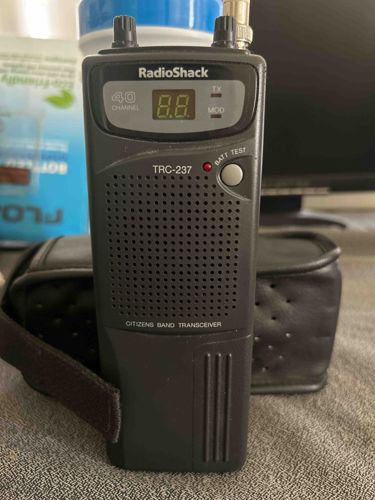
The item is a vintage RadioShack TRC-237 Citizens Band (CB) Transceiver, a handheld two-way radio. It is primarily composed of various shades of dark gray and black plastic, forming a rectangular, vertically oriented body with rounded edges. The front face features a prominent speaker grille at the bottom, characterized by numerous small perforations, and a black plastic control panel towards the top. Above the speaker grille is the model number 'TRC-237' printed in white, alongside a red LED indicator and a circular gray button labeled 'BATT TEST' for checking battery levels. The upper part of the front panel displays the 'RadioShack' brand name in white, and a green digital LED display shows '8.8.' indicating the channel, with '40 CHANNEL' printed to its left. To the right of the display, small labels 'TX' (transmit) and 'MOD' (modulation) with corresponding indicator lights are present. At the very top edge, two black plastic protrusions, likely used for attaching accessories or adjusting settings, are visible, along with a metal threaded connector for an antenna, which is partially visible. The overall construction appears utilitarian and robust, typical for portable communication devices of its era. On the lower part of the body, below the speaker grille, the words 'CITIZENS BAND TRANSCEIVER' are printed in white. Vertical raised lines are visible on the side of the unit, possibly for grip or design. The device shows minor signs of wear consistent with age and use, such as light scuffs or dust, but no significant damage like cracks or chips is immediately apparent. The screen appears functional with a clear green light. A black fabric strap is attached to the side, suggesting portability. A black leather-like carrying case, possibly original or aftermarket, is visible in the background, also showing some wear. This model likely dates from the late 1970s to 1980s, given the 'RadioShack' branding and the design aesthetic typical of that period for consumer electronics.
AI Appraisal Report
I have visually examined this RadioShack TRC-237 Citizens Band (CB) Transceiver based on the provided image. My assessment indicates a good vintage condition, consistent with its likely age from the late 1970s to 1980s. The unit presents minor signs of wear such as light scuffs and dust, but no apparent significant damage like cracks or chips. The digital LED display showing '8.8' suggests functionality, and the presence of a fabric strap and a leather-like carrying case adds to its completeness. The overall utilitarian design and branding are authentic to RadioShack products of that era.
Market conditions for vintage CB transceivers like the TRC-237 are generally modest. While there's a niche market among collectors of vintage electronics, particularly RadioShack memorabilia and CB enthusiasts, these items are not considered rare. Comparables for similar handheld CB radios of this vintage typically sell in the $20-$80 range, depending heavily on condition, functionality, and whether original accessories (like the antenna, manual, or case) are included. The visible carrying case is a positive factor. Demand is steady but not high-volume.
Factors significantly impacting value include confirmed working condition, the presence of the original antenna (which is partially visible but its condition unknown), and any original documentation. Without a physical inspection, I cannot confirm operational status, battery compartment condition, antenna integrity, or internal circuitry. Full authentication would require in-person examination to test functionality, inspect internal components for corrosion or modifications, and verify serial numbers against production records if available. My appraisal is limited by the visual nature of this examination.