AI estimate as of October 13, 2025 · verify with a professional before acting
AI-Generated · Verify before acting
Everything on this page is generated by AI for informational purposes only. AI can make mistakes — the AI may misidentify items or misattribute them (artist, maker, brand, designer, origin, era). This is not an official valuation and should not be used for insurance, sale, tax, estate, legal, or lending purposes — or any decision requiring a certified appraisal. It is not an authoritative claim about any person, brand, or rights holder — do not share or rely on it as a factual statement about a third party. Always consult qualified professionals before making financial decisions.
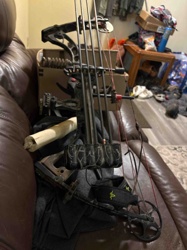
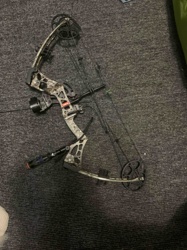
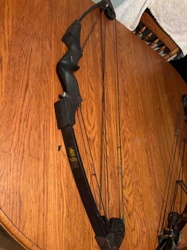
The item is a compound bow, characterized by its distinctive red limbs and black riser. The limbs appear to be constructed from a composite material, likely fiberglass or carbon fiber, giving them flexibility and durability, and are finished in a vibrant, almost neon, red color. The riser, which is the central part of the bow where the hand grip, sight, and other accessories are attached, is black and appears to be made of a rigid material such as aluminum or a high-strength polymer. The grip area shows a textured, possibly rubberized or wrapped, black section, designed for comfortable and stable handling. At both ends of the limbs, there are cam systems, which are mechanical pulleys critical to the operation of a compound bow, reducing the holding weight at full draw. These cams are visible and appear to be made of a metallic material, possibly aluminum, and are a light brown or bronze color. Black strings and cables traverse the length of the bow, connecting the cams and limbs. There's a visible string dampener or silencer on one of the strings. The overall condition appears to be used, but without significant visible damage like cracks or major abrasions that would impair function, though specific wear marks aren't entirely clear from the image. The bow seems to be of a modern design, likely from the late 20th or early 21st century. No specific manufacturer's marks or model names are discernible from the provided image. The craftsmanship appears functional and standard for a recreational or hunting compound bow.
AI Appraisal Report
Upon visual examination of the provided image, I assess this compound bow to be in good, used condition. The prominent red limbs and black riser present a modern aesthetic. Material composition appears standard for a recreational or hunting bow, with composite limbs and a rigid riser (likely aluminum or high-strength polymer). The cams, visible in a light bronze or brown, and the black strings/cables, along with a string dampener, all suggest a functional setup. There are no major visible flaws such as cracks, significant abrasions, or bent components that would immediately impair its functionality. However, specific wear marks, cam timing, or string fraying are not clearly discernible from the image alone.
Authenticity is difficult to fully verify without direct inspection. I cannot discern any manufacturer’s marks, model names, or serial numbers from the image. This significantly limits precise authentication and valuation. Without these details, it's impossible to confirm the brand, specific model, draw weight, or draw length, all of which are crucial for a precise appraisal. The bow appears to be a production model, not a custom-made item.
Market conditions for used, unbranded, or generic compound bows tend to be moderate. Demand exists for entry-level or backup bows, especially if in good working order. However, the absence of brand recognition, model specifics, and provenance keeps it from being a highly sought-after or rare item. Comparables would include other used, non-premium brand compound bows available on secondary markets. Factors impacting value negatively include the lack of identifiable features, an unknown age beyond 'modern design,' and the inherent limitations of selling used archery equipment without full specifications. Positively, its apparent good condition and modern design maintain a baseline value.
For full authentication and a more precise valuation, an in-person examination would be critical to identify any manufacturer markings, assess the actual physical condition of all components (limbs, cams, strings, cables, grip), verify draw weight/length, and check for any less obvious structural issues. Provenance documentation, such as original purchase receipts or owner history, would also be beneficial but is not expected for an item of this type. My current valuation range reflects a generic, functional, used compound bow.