AI estimate as of October 14, 2025 · verify with a professional before acting
AI-Generated · Verify before acting
Everything on this page is generated by AI for informational purposes only. AI can make mistakes — the AI may misidentify items or misattribute them (artist, maker, brand, designer, origin, era). This is not an official valuation and should not be used for insurance, sale, tax, estate, legal, or lending purposes — or any decision requiring a certified appraisal. It is not an authoritative claim about any person, brand, or rights holder — do not share or rely on it as a factual statement about a third party. Always consult qualified professionals before making financial decisions.
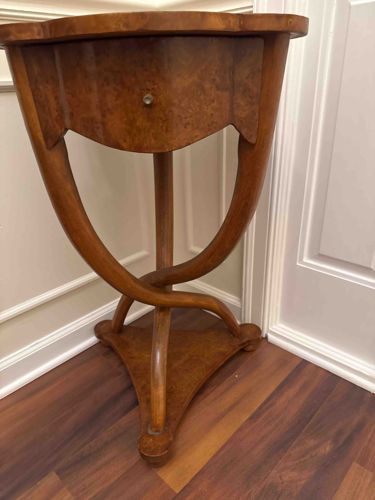
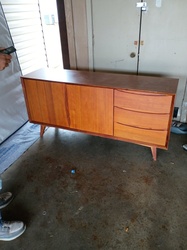
This is an elegant Art Deco style side table, likely crafted from burl wood, exhibiting a rich, warm brown tone with distinctive figure and grain patterns that are characteristic of burl. The table features a unique, scalloped or curvilinear shaped top, suggesting a deliberate design choice emphasizing organic forms. Below the tabletop, there is a small, single drawer, indicated by a subtle, circular wooden or possibly clear glass knob. The apron beneath the top is also curvilinear, flowing seamlessly into the support structure.
The most striking feature of this table is its distinctive leg design. Two elaborately curved legs sweep downwards from the underside of the table, crossing and intertwining in the center before fanning out to form a stable, tripartite base. A lower shelf, matching the burl wood of the top and drawer, is integrated into this base, providing additional utility and enhancing the aesthetic balance of the piece. The construction appears to be solid wood, with a polished finish that highlights the natural beauty of the burl. The overall condition appears to be good, with a visible patina consistent with age and use, though no significant damage like cracks or chips are immediately apparent from the image. The craftsmanship suggests a piece of quality, with careful attention to joinery and finishing. This type of design, with its blend of functionality and stylized form, is indicative of the Art Deco period, likely dating from the 1920s to 1940s.
AI Appraisal Report
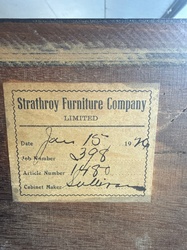
Upon examining the provided image of this Art Deco Burl Wood Side Table with Curved Legs, I assess it to be an authentic period piece, likely dating from the 1920s to 1940s. The distinctive curvilinear forms, scalloped top, and elegant, sweeping legs are quintessentially Art Deco. The burl wood displays a beautiful, complex figure, indicative of quality material and craftsmanship. The polished finish appears consistent with original period treatments, highlighting the wood’s natural beauty. Condition, based purely on visual inspection, appears very good, with a visible patina commensurate with age but no obvious chips, cracks, or significant structural damage. Minor surface wear or veneer lifting cannot be ruled out without physical inspection.
Market conditions for well-preserved Art Deco furniture, especially those incorporating luxurious materials like burl wood and featuring such distinctive design elements, remain strong. Comparable sales of similar-sized Art Deco burl wood side tables with unique forms typically fall within the $1,500 to $3,000 range, depending on condition and provenance. This piece's unique intertwined leg design and integrated lower shelf add to its aesthetic appeal and functionality, commanding a higher interest. Demand for authentic, stylish Art Deco pieces is consistent among collectors and interior designers.
Factors significantly impacting value here are the attractive burl wood, excellent apparent design, and good condition (as observed). Rarity is moderate, given the specialized design. A major limitation in authentication is the visual-only assessment. While the style and material strongly suggest authenticity, an in-person examination would be crucial to verify construction methods, examine veneer integrity, and assess for any restoration or repairs. Provenance documentation, if available, would further enhance value and confirm authenticity. Scientific testing, such as wood analysis, could definitively establish age, but is typically reserved for higher-value or contested pieces.