AI Appraisal Estimate

AI-generated estimates · not official valuations

From the user

What was submitted

Photo and notes provided by the user — not generated by AI

Submitted item photo
Submitted photo · June 6, 2026

User's notes

No additional notes provided.

AI analysis below

AI appraisal

AI analysis & estimate

AI-Generated · Verify before acting

Everything below is generated by AI for informational purposes only. AI can make mistakes — the AI may misidentify items or misattribute them (artist, maker, brand, designer, origin, era). This is not an official valuation and should not be used for insurance, sale, tax, estate, legal, or lending purposes — or any decision requiring a certified appraisal. It is not an authoritative claim about any person, brand, or rights holder — do not share or rely on it as a factual statement about a third party. Always consult qualified professionals before making financial decisions.

Read the full disclaimer

AI Identification

·Not independently authenticated·Verify before acting

Hand-Painted Floral Ceramic Lidded Box (Talavera Style)

Decorative Arts

AI Estimated Value

·Not an official valuation·Verify before acting

$75-125

As of June 6, 2026

AI Item Analysis

·AI can make mistakes·Verify before acting
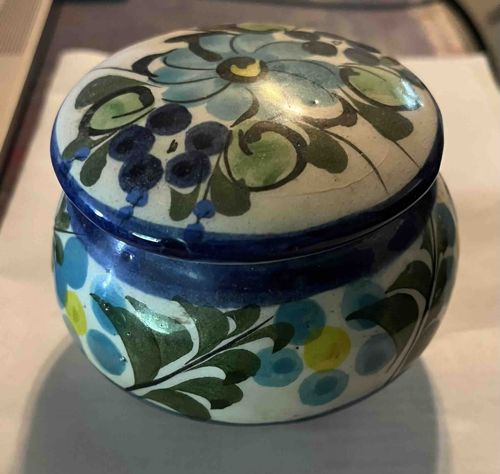
This is a hand-painted ceramic lidded box, likely of Talavera or similar folk art pottery tradition. The item is predominantly white, serving as a background for vibrant floral and botanical motifs. The lid is rounded and domed, featuring a large central flower with light blue petals, a yellow center, surrounded by dark blue berries or small circular elements and green leaves. The decorative elements on the lid are intricately arranged, indicating careful hand-painting. The body of the box is globular or squat, mirroring the rounded shape of the lid. It features a wide band of dark blue around its rim, where the lid rests, providing a clear separation from the body's design. The main body of the box continues the floral theme, with scattered light blue and yellow circular elements that could represent buds or abstract flowers, interspersed with green leaves. The overall color palette is bright and cheerful, dominated by blues, greens, and yellow against the white base. The ceramic appears to be glazed, giving it a glossy finish which enhances the vividness of the colors. Visible craftsmanship suggests hand-forming and hand-painting due to slight irregularities in the brushstrokes and patterns, which are characteristic of artisanal work rather than mass-produced items. No specific maker's marks or signatures are discernible from the provided images. The condition appears good overall, with no obvious chips, cracks, or significant wear visible, though minor surface irregularities consistent with handmade pottery may be present. The aesthetic points to a probable mid-20th century to contemporary period, embracing traditional folk art styles.
AI Appraisal Report

·AI can make mistakes·Verify before acting
Upon my virtual examination of this Hand-Painted Floral Ceramic Lidded Box, I assess its condition to be quite good, displaying no obvious chips, cracks, or significant wear. The vibrant colors and glossy glaze appear well-preserved. Its authenticity as a hand-painted ceramic, likely in the Talavera or a similar folk art tradition, is strongly suggested by the visible irregularities in brushstrokes and patterns—hallmarks of artisanal craftsmanship rather than mass production. This handmade quality significantly enhances its appeal. Current market conditions show a steady demand for decorative folk art pottery, particularly items exhibiting vibrant colors and traditional motifs. While not exceedingly rare, pieces that maintain excellent condition and demonstrate a high level of hand-painted detail, like this one, tend to hold their value. Comparables would include other hand-painted Mexican or Spanish Colonial revival ceramics of the mid-20th century onwards. The cheerful aesthetic and functional yet decorative nature of a lidded box contribute positively to its marketability. Factors significantly impacting value include its condition, the presumed handmade origin, and its decorative appeal. Without physically examining the piece, I cannot definitively confirm the specific regional origin (e.g., Puebla, Mexico vs. a similar tradition), nor can I ascertain the precise age beyond a likely mid-20th century to contemporary estimate. A full authentication would require in-person examination to check for firing imperfections indicative of age, potential maker's marks on the base hidden from view, and the quality of the ceramic body firsthand. Provenance documentation, though unlikely for such an item unless from a notable collection, would also be ideal. Scientific testing, such as thermoluminescence dating, could confirm age but is typically reserved for high-value archaeological pieces.

Get your items appraised

Instant estimates of your treasures with AI-powered appraisals

Browse More Appraisals